Showing posts with label wildlife. Show all posts

Friday, July 26, 2013

Summersweet Clethra

Summersweet Clethra has induced me end my blogging hiatus. Passing by a massing of this shrub yesterday, I was caught off guard by the fabulous scent. Dr. Dirr describes it as “delightfully fragrant.” It’s not a scent that is overpowering, but rather one of which you can’t seem to get enough.

Summersweet Clethra (Clethra alnifolia) is a large summer-blooming shrub that grows 3-8’ high and 4-6’ wide. The fragrant blooms are not terribly showy but will last 4 weeks or more. This plant is “tremendously pest free” and will do well in sun or shade and wet soils. Fall color is also a “worthwhile attribute.”

The pictured shrub is the ‘Ruby Spice’ variety which is a lovely soft pink. Bees, butterflies, and a variety of insects love this native plant. If you have an informal shrub border with some space, use this plant. And in other garden news, the American Plums are ripening!

Tuesday, March 6, 2012

plum crazy


Plums are a great addition to the edible landscape, and help to promote wildlife. (The bees were going crazy over this Chickasaw plum's blooms.) Three species that do well in our area with little input are American plum (Prunus americana), Wild Goose Plum (Prunus munsoniana), and Chickasaw Plum (Prunus angustifloia).

These native fruit trees can be large shrubs or small trees, hybridize amongst themselves, and tend to form colonies when left to their own devices. White spring blooms give way to red, orange, and yellow fruit in late summer. Plant a few plums for optimal pollination.

Eaten fresh, baked, or processed into jams or wine, the possibilities are mouth-watering and easy to attain. These plums will do well in partial shade to full sun, bearing fruit in just a few years. Keep in mind, native plums are smaller than the European varieties you may be used to at the grocery store.

Friday, August 20, 2010

a bird in the hand...


The focus of this blog posting is not a plant, but rather a precious animal that came into our lives this week. Freddie, as we have come to call him, is a baby blue bird that I found outside the back door Tuesday night. He was on his back and thrashing about just steps from where I park my car in the driveway. (It should be noted that we aren’t quite sure what this bird’s sex is, but he looked like a Freddie to me so we just went with it).

It took me a few seconds to realize he was a baby bird, because he didn’t even have all his feathers yet. Once I turned him over on to his belly (I was wearing gloves), he immediately fell back on his side, and started making the sweetest chirping sounds I’ve ever heard. Evidently, this little guy could barely even walk. I cradled him in my hands and he rested there, silent and exhausted. I have no idea how long he had been struggling.

I placed him, gloves and all inside the mesh fencing that surrounds the tomatoes, thinking he would at least be safe from most predators until I could figure out what to do. I called Walden’s Puddle*, a fabulous resource for injured and orphaned wild animals in middle Tennessee, and left a message.

Their outgoing message had some extremely helpful information. As per their instructions I looked for a nest but couldn’t find one. (It was getting dark, and there are not many tree branches that could be easily reached.) They recommend bringing nestlings inside overnight, and keeping them in a small box with rags.

When Whit got home, we went to work making an appropriate box/shelter for him and relocating him inside. It’s really important not to handle baby birds very much, they are so fragile. I was surprised at how involved Whit wanted to be with helping this baby bird. I could tell Freddie had gotten to Whit too, and we were both going to do what we could to help this little guy.

[It’s important to differentiate nestlings from fledglings, since fledglings should be left alone. Nestlings are baby birds without all their feathers that spend all of their time in the nest being fed and staying warm. Fledglings are baby bids that are fully feathered and experimenting with flight, while being watched from afar by their parents.]

Have you ever heard that momma birds will abandon their young because of the scent of a human? This is a myth! The only time a mother might abandon her young because of human interference is if she sees her eggs have been tampered with, because this means a predator may be nearby.

I could tell Freddie was hungry; Nestlings are usually fed once an hour. So as per Walden’s Puddle’s instructions, we attempted to feed Freddie soggy dog food. In this way, as Whit pointed out, even Cooper was helping our foster bird child. We put a small amount on the tips of our fingers and Freddie sucked away. Feeding Freddie was one of the sweetest things I’ve ever been a part of, Whit even got a little misty-eyed.

The next challenge was keeping him warm. Walden’s Puddle suggests placing a heating pad under the box, but we didn’t have one available. My electric range top stays warm when the oven is on, so we kept the oven on low all night and set Freddie’s box on top of the electric range. (Whenever I start to tell this part of Freddie's story, people always have the most horrified look on their face when I mention the word oven.)

On Wednesday morning, Freddie awoke with even more energy than the night before. It was surreal to hear a bird chirping in the kitchen. I was thrilled that he had made it through the night. We fed him some more, and I decided to work from home until Walden’s Puddle called me back and I could drop him off there.

But I was still determined to figure out where this little guy had come from, and set out to find the nest once more. Low and behold, I found it! It was in a flower pot about halfway up the Baker’s rack I keep on my deck by the back door. There in the back of the pot was a nest made out of moss, and three baby birds that looked just like Freddie!

This would mean that Freddie fell out of the nest (several feet down), somehow got to the edge of the deck (about 6’ away), and then fell another few feet down to get to where I found him. I was skeptical that he could do all this maneuvering but this had to be his nest! I called Whit at work to let him know and set about reuniting Freddie with his family.

I took a few last pictures of Freddie and then placed him back in the nest with his siblings. I peeked out the window a few hours later and saw what I presume to be the momma bird, worm in mouth, making her way to the nest. I wish the nest was positioned in such a way that we could watch the goings on from inside, but alas we cannot.

A few hours later, Whit asked me how Freddie was doing and I looked out the window to see a little baby bird trying to stand up on the deck floor. I’m pretty sure Freddie had fallen out of the nest again. I quickly picked him up and put him back in his nest and started fretting about whether that had been the right nest, whether his siblings/mom had rejected him.

On Thursday, Whit counted FOUR baby birds in the nest and I was so relieved. Come to find out, blue birds often build their nests about 4’ off the ground. Also, they can have several broods a season and the older siblings typically help care for the new babies. It makes me feel better imagining an extended of family of birds watching over these 4 precious babies.

I’m hopeful Freddie and all the nestlings stay in the nest until they have more feathers and/or start to practice flying under the tutelage of their bird parents. I'm excited and nervous about watching Freddie and his siblings practice flight. I definitely feel like I have a vested interest in this brood and their well-being, and I look forward to updating everyone on their status.

A big ‘thank you’ to Walden’s Puddle* for providing us with the information necessary to help Freddie. It is such a wonderful non-profit organization, which like many these days is struggling to make ends meet. They are actually having a fundraiser this weekend, tickets and information can be found here.

*Walden’s Puddle is a non-profit organization dedicated to the rehabilitation of wildlife by providing treatment and care for sick, injured, and orphaned wildlife, as well as encouraging education which promotes a greater understanding and appreciation for wildlife and its habitat. Walden’s Puddle is unique in being the only professionally staffed non-profit organization and wildlife rehabilitation facility in Middle Tennessee.

Walden’s Puddle is properly chartered as a charitable non-profit corporation by the State of Tennessee and is approved by the Internal Revenue Service as a 501c3 organization. All donations are tax deductible. 615-299-9938 / P.O. Box 641 Joelton, TN 37080

Tuesday, August 17, 2010

guarding my garden!


Despite the 4’ tall mesh fencing, some critter/person is still nabbing all of my ripe Roma and Big Boy tomatoes, and stomping all over my Sedum in the process. For whatever reason, the Black Cherry’s have remained safe, and I’m hoping Mr. Stripey will look so strange to the tomato thief that those will be passed by as well.

I think I reached the peak of exasperation last week when once again we realized we had been had; without sign of a struggle with the fence or remnants of the ill-gotten treasure, it was gone without a trace. I became convinced that stealing someone’s vegetables was the lowest form of larceny, and began devising plans for video surveillance of the garden.

Maybe garden surveillance is a bit extreme, but short of that I'm running out of options. The 'Roma' and 'Big Boy' are still growing so much and I'm hopeful that I will be able to harvest just a few more this season. They are growing so much in fact that I had to use the nearby Butterfly Bush branches for support!

It is extremely frustrating to not be able to enjoy the proverbial ‘fruit’ of my labor, and equally frustrating that I’m not able to share with friends and neighbors. On a positive note, I have discovered that grilling cherry tomatoes is absolutely fabulous. We now put them on skewers with other chopped veggies and they have such a great flavor!

The basil is kicking it up a notch and the Rose of Sharon has really hit its stride too. My peppers have slowed down, and I finally cut back the Baptisia. Thankfully, I was able to collect some Hollyhock seeds before I cut them back to the ground; I’ll start those in the greenhouse this fall.

I have especially enjoyed watching the Monarch butterflies flutter around the Butterfly Bush lately. To watch them float around the lilac blooms is like witnessing an ethereal dance that defies gravity. Their elegant movements will mesmerize any visitor to the garden. These are truly amazing animals and I feel honored to host them on their migration.

Wednesday, June 16, 2010

tall tomatoes and such


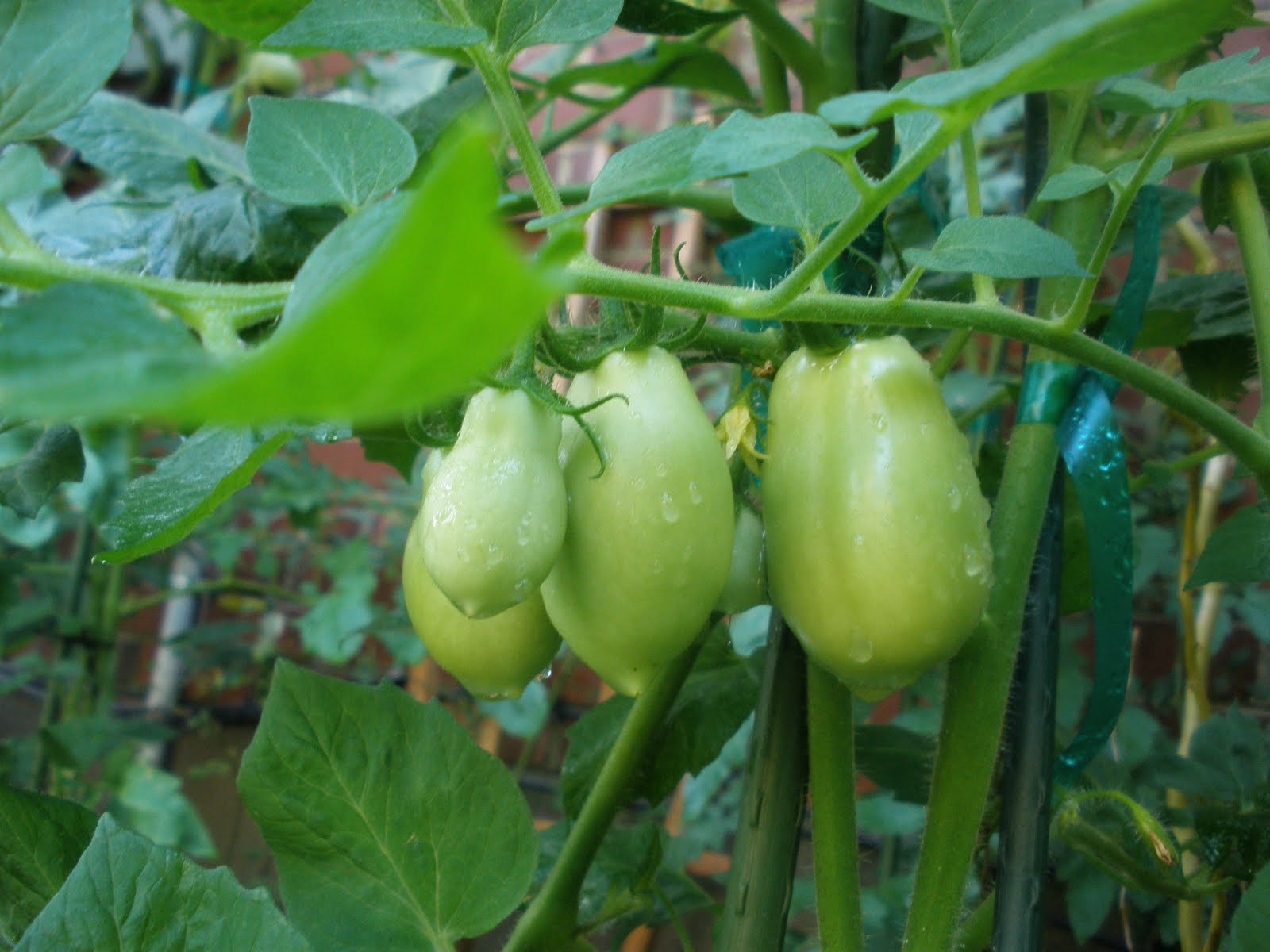
Now my tomatoes are taller than me, 5'-5". Well Big Boy and Black Cherry are at least, with Roma (pictured) right behind. Mr. Stripey had a later start and I’ve even relocated him once so I’m not surprised his growth is dwarfed by the others. I may have to buy several more, larger stakes to secure the three larger tomatoes, which continue to reach for the heavens.

The three large tomato plants all have multiple baby tomatoes that grow larger and more numerous everyday. I need to prune out some of the excessive foliage and suckers ASAP. And, I have a baby jalapeƱo! So far, however, that’s my only pepper.

I won’t be posting photos of my herb pot anytime soon, it has seen better days. The thyme is doing great and the parsley is fine, the variegated basil even looks to be making a comeback. But the cilantro has ‘gone to seed’ and looking worse each day. I’m hoping I’ll be able to harvest some coriander, but I’m not holding my breath.

I have planted a new basil plant and hope to add others as I count more tomatoes everyday! The Rosemary is doing great and has probably doubled in size since I planted it earlier this year. And the mint is going gangbusters, taking over the driveway planting bed.

Also in the driveway planting bed, the last remaining Hollyhock flower buds are blooming. Still all white! And the Rose of Sharon (pictured) has begun to bloom! I have counted only two blooms so I’m hoping for more. It is one of my all-time favorite flowers; admittedly this may be because they remind me of my grandparents, but nonetheless, gorgeous.

Back across the drive, in the west side planting bed, the Black-eyed Susans have begun to bloom. They will look great alongside the pinkish reds of the sedums and daylilies close by. Along with the tiger lilies, the pink/red, orange, yellow combination is actually quite lovely.

Also, I have discovered that a beloved annual, Verbena bonariensis, has reseeded itself. While not the most ideal location (in the front of the flower border), it’s a welcome surprise! This annual has rose purple flower clusters at the end of slender square stems growing 4’ or more in height.

I prefer this plant in the back of the flower border, and often pinch it back a few times to induce a more compact habit. Once it starts blooming, you will have color on into the fall. Another benefit is this plant attracts butterflies and gold finches. The only downside is an occasional powdery mildew episode; if this occurs, I just cut back all affected foliage.

And finally, a favorite perennial planted on the bank at the rear property line, the evening primrose (Oenothera), has begun to bloom! I don’t know much about this plant, but I’m delighted that it seems to have spread and I now have at least twice as many plants as last year. [I believe it spreads by seed, because one popped up in a nearby pot.]

I’m amazed that this inconspicuous plant has thrived where it has, competing with the likes of ivy and euonymus. As the name suggests, swirls of buttery yellow blooms open up after the sun goes down. It’s great in combination with the tiger lily; especially since they both bloom at a height of 3-4’. The flowers are truly beautiful, and the perfect crescendo to a summer day.