Showing posts with label winter. Show all posts

Wednesday, February 27, 2013

2013: Damp & Cold


To paraphrase Steinbeck's East of Eden, February of 2013 was a year heavy with water. And it has been; at 10”, Nashville is 30% above average precipitation for the year. We have also had several wind storms which caused downed trees and power lines. My neighbors had two cars totaled after a recent wind storm; the ground was just too saturated to hold a large precarious tree, which luckily missed their house when it fell.

The wet weather has been great for any new trees planted this winter, and for all early blooming trees, shrubs, and flowers. It’s a relief to see Flowering Quinces, Daffodils, Hellebores, and Cherry trees blooming, only 21 days till spring! This year’s Vernal Equinox is on March 20th. And just one day after is a lecture on native plants and rain gardens at the Shelby Bottoms Nature Center by Mike Berkley of GroWild, more info here.

In my own garden I am cutting back anything yet to be cut back, mulching, and planting. I still need to severely prune my butterfly bushes and camellias, as well as plant a new Rhododendron. There are still several weeks left in the ideal planting window to get any last minute trees or shrubs in the ground before bud break. I am so looking forward to longer days and weather better suited to spending time outside!

Wednesday, February 15, 2012

february blooms


Looking back at my garden notes from Februaries past, one thing’s for sure, plants are blooming earlier. This has been a whacky winter; and by whacky I mean mild and wonderful. I’ve actually enjoyed spending time outdoors throughout most of this winter, which is in stark contrast to the incredibly snowy winter Nashville saw last year.

Flowering Quince (Chaenomeles), Daffodils (Narcissus), Lenten Rose (Helleborus), and Witchhazel (Hamamelis) lead the charge (and the Camellias are still blooming!). The thought of grouping all late-winter blooming plants together in one composition seems a perfect way to combat winter blues. And while ordinarily opposed to such theme gardens, this is one I’d like to try.


Monday, January 16, 2012

frost can be hell


“How can it be that after a frost the entire garden looks as if it had been to a party in hell?” asks garden writer Jamaica Kincaid in the piece “A Fire by Ice." This paradox is present throughout the winter experience, not just in the garden. Alluding to symptoms of frostbite, have you ever heard the expression, ‘cold enough to make your skin burn?’ Tissue damage from cold weather is destructive to plant and skin cells alike.

Every fall and spring, many tender and deciduous plants experience this damage. But even winter annuals can show signs of frost damage throughout the season. Pansies are notorious for this. As the internal temperature in various tissues of the plant become cold enough to break cell walls or spoil cell components, damage, wilting, and death may occur.

Healthy plants will usually survive short periods of extreme low temperatures. The best way to prevent and treat frost-damaged winter annuals is to mulch sufficiently and water regularly. It’s easy to forget to water winter annuals; but for most of the country winter months are the driest.  Remember that even when the plant isn’t actively growing, the roots are still developing. 

Thursday, October 20, 2011

happy birthday to me


Camellia, one of my favorite flowers, blooms each year on my birthday. There is a hedge of Sasanqua Camellias planted along the back side of my house, which I started from cuttings while a student at the University of Georgia in Athens. Camellia’s aren’t thought of as particularly cold hardy (especially Sasanquas); but these have survived several cold Nashville winters and now stand over 5’ tall.

Sasanqua Camellias bloom earlier and are more demure in flower and leaf size than their cousin, the hardier Japanese Camellia (Camellia japonica). Another cousin, the Tea Camellia (Camellia sinensis) is not nearly as showy as the other species. But its value lies in creating more cold-hardy crosses, and it is the plant from which tea is made!

The Camellia’s blush white to deep red flower stands out well against its dark evergreen foliage. And while I have planted specimens of this shrub for a few clients, I prefer to see them in groupings. My favorite grouping is at the Founder’s Memorial Garden at the University of Georgia, where Camellia hedges create walls of lush foliage and colorful blooms.

Between my love of UGA’s campus and my reverence for cold-weather blooms, I was destined to adore this shrub. Camellia’s are much more versatile and low maintenance than many realize. For a safe bet on cold hardiness, select a Camellia variety with ‘winter’, ‘snow’, or ‘ice’ in the name. Most prefer some shade and moist, well-draining, slightly acidic soil.

Monday, January 31, 2011

first blooms of 2011!


As big snowflakes flurried around Nashville this morning, I saw the first signs that spring is in fact right around the corner…daffodils peeking through the soil! It will still be several weeks before they bloom, but it is exciting nonetheless. Today I was also greeted by the first bloom of 2011, Witchhazel (Hamamelis vernalis).

Witchhazel is a beautiful large shrub of which there are several native varieties. Landscape features include gorgeous yellow fall color and pungently fragrant yellow/orange flowers in late winter. This is a great shrub for massing in the back of a naturalized border planting. “A tough plant with an alley-cat tenacity” says woody plant expert, Dr. Dirr.

Another plant on my bloom watch list is the Lenten Rose (Helleborus). Speaking of Lenten Rose, the person who introduced me to that amazing perennial, Dr. Allan Armitage has revised Armitage’s Garden Perennials. The new version will be out this summer and is a must-have book for any perennial gardener.

Last weekend I took advantage of extraordinarily mild temperatures to finish cutting back all remaining perennials and mulching a few of the planting beds. Working in the garden, I noticed how graceless my large butterfly bush has become. I’m going to have to cut it back and remove a lot of water sprouts before it leafs out.

[Water sprouts are vigorous growths along a branch that grow almost vertically and are aesthetically displeasing.]

This time of year can be down-right depressing with grey days and freezing temperatures. Knowing that spring will soon be here provides some relief from winter doldrums. Until then, I will keep thumbing through garden catalogues and dreaming of warmer days and the beautiful blooms to come!

Tuesday, January 4, 2011

winter gardening


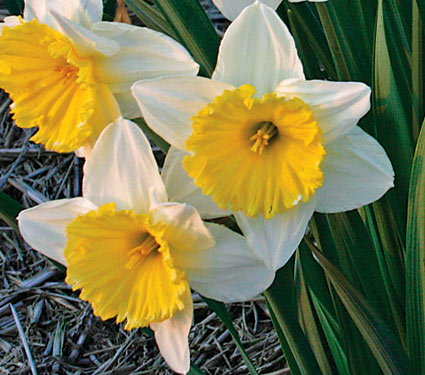
I planted a handful of daffodils last weekend. The image to the left is 'Ice Follies'; can't wait to see them come up this spring! I was pleased to find that it was relatively easy to dig the 6" daffodil holes in most areas of the garden. I sprinkled a few by the back door, some on either side of the front steps, and a few on the other side of the driveway.

While I was digging, I noticed that the pachysandra has spread even more, with little shoots coming up about 12-18" from the large clump near the back door. This time of year, garden troopers like Pachysandra and Lenten Rose (Helleborus) really shine while everything else is dormant.

Wednesday, March 17, 2010

a good day to be GREEN


Spring is upon us. Everyday, driving around town, I notice the new blooms of daffodils, crocus, cherry trees, and witch-hazel. But the only thing blooming in my garden right now is Helleborus orientalis, the Lenten Rose. This is one of my favorite perennials. It is beautiful, evergreen, versatile, durable, hardy, and above all else, extremely low-maintenance. What more can you ask for in a perennial?

I was first introduced to this awesome plant by Dr. Allan Armitage, while a student at UGA. He is one of the foremost perennial plant experts and a big proponent of Hellebores. While I call most plants by their botanical (genus) names, it is rare that most people (non-horticulture-types) would do the same. The Hellebore, I’ve found, is one of the exceptions to this rule. Another interesting thing about Hellebores is that the blooming part of the plant is not actually a ‘flower’ or ‘petals’ at all, rather they are sepals, or modified leaves.

There are generally two species of Hellebores available at retail garden centers: Helleborus orientalis (Lenten Rose), and Helleborus foetidus (Stinking Hellebore). Helleborus orientalis is the only one in my garden, so that’s what I’m talking about when I say ‘Hellebore’. However, H. foetidus is a lovely perennial in its own right with many of the same characteristics, but having finer leaf texture. [Also, I don’t find that it particularly smells bad and I’m afraid its common name may turn people away from a perfectly good plant.]

An evergreen perennial, Hellebores can form clumps of dark green, coarse foliage with blooms reaching 18”. There size increases over time, but I generally think of them as 12” tall perennials. Hellebores do well in full shade and full sun. However, the best balance of foliage and blooms probably occurs in a partial shade environment. Full sun exposure produces prolific blooming, but can scorch the edges of leaves. Hellebores will become quite drought tolerant once established, but prefer regularly moist soils.

Obviously there is a connection between the common name and the bloom time, Lent. It’s a great time to have something blooming in the garden since everyone I know is incredibly anxious for spring right now. Hellebores do not have very showy flowers, but the bloom is so beautiful and intricate, I find myself on hands and knees trying to get a better look. The true species has a creamy white-pink bloom that faces slightly downward and can have darker-hued splotching or fading on the interior of the sepals.

Hellebores have been cross-bred so many times that there is a kaleidoscope of color options to choose from. Blooms range from white, green, pink, purple, and everything in between. Sometimes there will be different colored-blooms on the same plant. Newer hybrids have created more compact and upright blooming varieties such as ‘Ivory Prince’, which is becoming very popular in the trade. The Hellebores in my garden bloom shades of pink, from rosy-pink to a purple-pink, the richness of which is hard to find elsewhere. Although gorgeous, this darker color does not stand out in the garden as well as the lighter blooming varietals.

I use Hellebores in my garden as accents in the perennial border alongside ferns, epimediums, and gingers. But they can make excellent groundcovers as well. They are highly effective when planted en masse for a bold flower display in late winter and a carpet of lush foliage throughout the year. The only maintenance I perform is occasionally removing scorched leaves in late summer/fall and spring fertilization when I fertilize the planting bed, that’s it!

I’ve been told (and have witnessed this in Dr. Armitage’s garden) that hellebores reproduce from seed eagerly. I have not yet experienced this in my own garden, but I remain hopeful; mainly because they are one of the more expensive perennials to purchase. Hellebores are native to Europe and Asia, but they will not displace our native species, so I advise planting as many as possible if you like what you read. I find Hellebores available for purchase year-round but I suggest buying them now, so you can see the flower color.

On a side note, the 6 Hollyhock seedlings are still surviving in the greenhouse and at least 3 plants appear to have over-wintered in my garden. This would be reason enough to celebrate but lucky for me it’s also St. Patrick’s Day! Happy Gardening!