Showing posts with label hellebore. Show all posts

Wednesday, February 15, 2012

february blooms


Looking back at my garden notes from Februaries past, one thing’s for sure, plants are blooming earlier. This has been a whacky winter; and by whacky I mean mild and wonderful. I’ve actually enjoyed spending time outdoors throughout most of this winter, which is in stark contrast to the incredibly snowy winter Nashville saw last year.

Flowering Quince (Chaenomeles), Daffodils (Narcissus), Lenten Rose (Helleborus), and Witchhazel (Hamamelis) lead the charge (and the Camellias are still blooming!). The thought of grouping all late-winter blooming plants together in one composition seems a perfect way to combat winter blues. And while ordinarily opposed to such theme gardens, this is one I’d like to try.


Tuesday, March 8, 2011

11 days til spring!


The Hellebores (pictured) are looking better everyday. Peonies are starting to come up out of the ground; their little red spikes look other-worldly. I’ve also noticed the Star Magnolias (Magnolia stellata, pictured) blooming around town. There is nothing quite like a deciduous magnolia’s bloom, and if I had room in my garden, I’d plant one!

Last weekend I cut back all of my Catmint (Nepeta) to reveal new leaves at the base of the plants. It has rained a lot here lately and the damp ground made weeding out maple seedlings that were overwintering in my planting beds much easier.

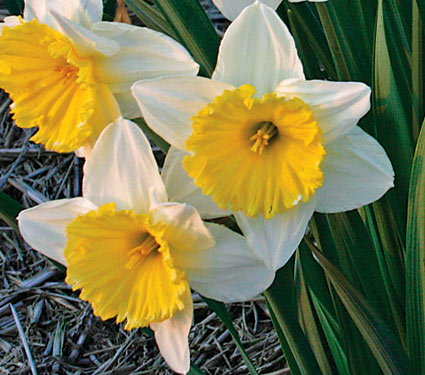
More daffodils (Narcissus) are popping up, including King Alfred, which is another good trumpet variety. Daffodils make fantastic cut flowers; cut three stems for a simple (and fragrant!) arrangement.

Another garden task to be done this time of year: soil testing. Soil tests are fairly cheap (about $7 in Davidson County), can be performed at your local county extension office. I recommend testing every two years, or every year if you’re trying to correct a serious problem like pH.

Also, I planted an onion that had sprouted in my kitchen; not sure how that will fare outdoors, but I plan on eating the sprouts in a future salad. Now is a good time to plan the veggie garden and purchase seeds.

I bought lettuce, Swiss chard, and carrots to try from seed this year. All of these should be planted 3-4 weeks before the last average frost date. So I’ve marked March 20th (first day of spring!) on my calendar to kick off my vegetable garden. To find your last frost date, check here.

According to the Environmental Working Group, carrots and lettuce are a few veggies that contain high concentrations of pesticides. This isn’t surprising since these plants all have ‘thin skins.’ Because of this (and so many other reasons), I’ll be eating as much as I can from my own garden, and relying more on my CSA this year.

To find a participating farm near you, visit localharvest.org. In Nashville, I recommend Fresh Harvest.

Friday, February 25, 2011

Only 23 Days 'til Spring!


Currently, there are several blooming plants in the garden: Witchhazel, Hellebore, Forsythia, and Daffodil! What’s interesting is that three of these four bloomers are yellow. I happen to like yellow, think it’s a fresh and exciting color. But you may be surprised that in talking to clients, it’s one of the least favored flower colors.

Some of the Witchhazel (Hamamelis) varieties are still blooming and the fragrance is quickly becoming one of my favorite. It’s a sweetness tinged with citrus that makes you literally stop in your tracks to take in the aroma, delightful!

The Hellebores started blooming this week, and that show will go on for months. One of my favorite perennials, this plant is a real trooper. I went through and clipped out any tired-looking foliage, which made the flowers stand out even more. My hellebores are lavender blooming, but I love the white and speckled varieties just as much.

Forsythia is a great shrub to use en masse, if you have a large area to devote to them. But more often then not, they are (over) planted in small areas and pruned incorrectly. What results is a boxy-looking shrub with sparse flowers. This plant will grow 10’ tall and needs delicate pruning immediately after flowering to ensure a good show next year.

Rijnveld’s Early Sensation Daffodil (Narcissus) is the earliest hardy daffodil to bloom. It is classified as a trumpet daffodil, which means it has one of the larger blooms of the species. The two-toned yellow blooms stand about 12” tall, and will keep blooming despite any future blankets of snow.

There’s only 23 more days until spring, let the count down begin!

Monday, January 31, 2011

first blooms of 2011!


As big snowflakes flurried around Nashville this morning, I saw the first signs that spring is in fact right around the corner…daffodils peeking through the soil! It will still be several weeks before they bloom, but it is exciting nonetheless. Today I was also greeted by the first bloom of 2011, Witchhazel (Hamamelis vernalis).

Witchhazel is a beautiful large shrub of which there are several native varieties. Landscape features include gorgeous yellow fall color and pungently fragrant yellow/orange flowers in late winter. This is a great shrub for massing in the back of a naturalized border planting. “A tough plant with an alley-cat tenacity” says woody plant expert, Dr. Dirr.

Another plant on my bloom watch list is the Lenten Rose (Helleborus). Speaking of Lenten Rose, the person who introduced me to that amazing perennial, Dr. Allan Armitage has revised Armitage’s Garden Perennials. The new version will be out this summer and is a must-have book for any perennial gardener.

Last weekend I took advantage of extraordinarily mild temperatures to finish cutting back all remaining perennials and mulching a few of the planting beds. Working in the garden, I noticed how graceless my large butterfly bush has become. I’m going to have to cut it back and remove a lot of water sprouts before it leafs out.

[Water sprouts are vigorous growths along a branch that grow almost vertically and are aesthetically displeasing.]

This time of year can be down-right depressing with grey days and freezing temperatures. Knowing that spring will soon be here provides some relief from winter doldrums. Until then, I will keep thumbing through garden catalogues and dreaming of warmer days and the beautiful blooms to come!

Tuesday, January 4, 2011

winter gardening


I planted a handful of daffodils last weekend. The image to the left is 'Ice Follies'; can't wait to see them come up this spring! I was pleased to find that it was relatively easy to dig the 6" daffodil holes in most areas of the garden. I sprinkled a few by the back door, some on either side of the front steps, and a few on the other side of the driveway.

While I was digging, I noticed that the pachysandra has spread even more, with little shoots coming up about 12-18" from the large clump near the back door. This time of year, garden troopers like Pachysandra and Lenten Rose (Helleborus) really shine while everything else is dormant.

Tuesday, June 8, 2010

baby tomatoes!


While replacing the tomato stakes last weekend, I discovered I had baby tomatoes! There are baby Roma’s, and Black Cherry tomatoes. Still no fruit on any of the pepper plants or Big Boy and Mr. Stripey, but all have flowers. I think I’m still on track to be harvesting the first tomatoes at the end of the month.

The status of the herb ‘garden’ is virtually unchanged. I did have an opportunity to use some mint in a recipe I tried last week, Jamie Oliver’s ‘mini shell pasta with a creamy smoked bacon and pea sauce’ from his book, Food Revolution. It turned out quite well, click here for a link the recipe.

The Hollyhocks are still blooming (all white) and while I get annoyed with the mint most of the time, it is nice to have something covering up the Hollyhock’s unsightly legs. Also in the driveway planting bed, there are many flower buds forming on the Rose of Sharons, and the butterfly bush and black eyed susan’s that I relocated to the driveway bed are also doing well.

Out front, the Hellebores still have flowers, and the Oakleaf Hydrangeas are doing so well. This seems to be a particularly good year for hydrangeas in our area. ‘Not of this World’ is the first of my Daylilies to bloom, and the tiger lilies are still going strong. In the west side planting bed, the sedum is also about to bloom.

I’ve only had to water a few times all season, thankfully; that has saved time and money. I’m still fertilizing the veggies and herbs once or twice a week with a liquid fertilizer, but that’s really the only maintenance I’ve had time for lately.

Thursday, May 27, 2010

bugs are gone!


The ant/aphid infestation on my Rose of Sharon is completely gone. And since spraying my hollyhocks with Sevin I haven’t seen any more hollyhock sawfly larvae chomping away. They still haven’t bloomed, but I’m hopefully every day when I come home from work to catch a glimpse of color.

Last weekend I removed a portion of my Black-eyed Susan’s in the west side planting bed to make room for two more pepper plants and give my rosemary some more space. In addition to the new red and green bell peppers, I also planted an heirloom tomato in the driveway planting bed. I’m hoping it will get enough sun there, because I’m running out of space elsewhere.

Mr. Stripey, as he’s called, is an old-fashioned beefsteak that will have yellow and red stripes outside and mostly yellow coloring inside the fruit. It has tiny leaves and the flavor is supposed to be sweet and mild. We’ll see in approximately 56 days!

I think I initially underestimated the support my tomatoes would require. But now I regret skimping on the stake size, because my ‘big boy’ and ‘black cherry’ tomatoes have already grown almost to the top of their stakes. So, I will have to purchase taller/stronger stakes to support these veggies and re-tie all of the tomatoes. Bummer.

I also (finally) replaced the pansies in my pots by the front steps with a ‘lemon chiffon’ million bells (Calibrachoa) in each pot. I’m not usually one for monochromatic pot plantings, but my front door is hardly used and there’s enough going on in the nearby planting beds to warrant simple pots.

My oakleaf hydrangea (Hydrangea quercifolia) have started blooming on both sides of the front door and look really great behind my patch of catmint (Nepeta) to the right of the front door. To balance that, the Nepalese columbines I planted on the left side of the front door bloomed well and are slowly taking over one side of that planting bed.

The Hellebores are still blooming and look great next to the sensitive ferns (Onoclea sensiblis) out front. My Iris have finished blooming and I need to weed the bed by the mailbox to get it ready for the daylilies which will start to bloom soon.

The only other annual I have added this season is a ‘Mini Blue-Veined’ Supertunia. I added this to my blue pot with the Salvia and Spirea. The salvia has already started blooming and the Spirea will soon follow.

My herb pot is not looking so good. The cilantro started to bolt last week, so I cut off some of the flower buds. The basil, which has been looking ill ever since the floods, now looks awful. My parsley and thyme are the only things doing well. They seem to have had good drainage and decent sun where they are. I may have to start over with new cilantro and basil, maybe even from seed.

Wednesday, March 17, 2010

a good day to be GREEN


Spring is upon us. Everyday, driving around town, I notice the new blooms of daffodils, crocus, cherry trees, and witch-hazel. But the only thing blooming in my garden right now is Helleborus orientalis, the Lenten Rose. This is one of my favorite perennials. It is beautiful, evergreen, versatile, durable, hardy, and above all else, extremely low-maintenance. What more can you ask for in a perennial?

I was first introduced to this awesome plant by Dr. Allan Armitage, while a student at UGA. He is one of the foremost perennial plant experts and a big proponent of Hellebores. While I call most plants by their botanical (genus) names, it is rare that most people (non-horticulture-types) would do the same. The Hellebore, I’ve found, is one of the exceptions to this rule. Another interesting thing about Hellebores is that the blooming part of the plant is not actually a ‘flower’ or ‘petals’ at all, rather they are sepals, or modified leaves.

There are generally two species of Hellebores available at retail garden centers: Helleborus orientalis (Lenten Rose), and Helleborus foetidus (Stinking Hellebore). Helleborus orientalis is the only one in my garden, so that’s what I’m talking about when I say ‘Hellebore’. However, H. foetidus is a lovely perennial in its own right with many of the same characteristics, but having finer leaf texture. [Also, I don’t find that it particularly smells bad and I’m afraid its common name may turn people away from a perfectly good plant.]

An evergreen perennial, Hellebores can form clumps of dark green, coarse foliage with blooms reaching 18”. There size increases over time, but I generally think of them as 12” tall perennials. Hellebores do well in full shade and full sun. However, the best balance of foliage and blooms probably occurs in a partial shade environment. Full sun exposure produces prolific blooming, but can scorch the edges of leaves. Hellebores will become quite drought tolerant once established, but prefer regularly moist soils.

Obviously there is a connection between the common name and the bloom time, Lent. It’s a great time to have something blooming in the garden since everyone I know is incredibly anxious for spring right now. Hellebores do not have very showy flowers, but the bloom is so beautiful and intricate, I find myself on hands and knees trying to get a better look. The true species has a creamy white-pink bloom that faces slightly downward and can have darker-hued splotching or fading on the interior of the sepals.

Hellebores have been cross-bred so many times that there is a kaleidoscope of color options to choose from. Blooms range from white, green, pink, purple, and everything in between. Sometimes there will be different colored-blooms on the same plant. Newer hybrids have created more compact and upright blooming varieties such as ‘Ivory Prince’, which is becoming very popular in the trade. The Hellebores in my garden bloom shades of pink, from rosy-pink to a purple-pink, the richness of which is hard to find elsewhere. Although gorgeous, this darker color does not stand out in the garden as well as the lighter blooming varietals.

I use Hellebores in my garden as accents in the perennial border alongside ferns, epimediums, and gingers. But they can make excellent groundcovers as well. They are highly effective when planted en masse for a bold flower display in late winter and a carpet of lush foliage throughout the year. The only maintenance I perform is occasionally removing scorched leaves in late summer/fall and spring fertilization when I fertilize the planting bed, that’s it!

I’ve been told (and have witnessed this in Dr. Armitage’s garden) that hellebores reproduce from seed eagerly. I have not yet experienced this in my own garden, but I remain hopeful; mainly because they are one of the more expensive perennials to purchase. Hellebores are native to Europe and Asia, but they will not displace our native species, so I advise planting as many as possible if you like what you read. I find Hellebores available for purchase year-round but I suggest buying them now, so you can see the flower color.

On a side note, the 6 Hollyhock seedlings are still surviving in the greenhouse and at least 3 plants appear to have over-wintered in my garden. This would be reason enough to celebrate but lucky for me it’s also St. Patrick’s Day! Happy Gardening!