Showing posts with label vegetable. Show all posts

Tuesday, August 23, 2011

cucumber salad


The garden is growing well. The knockout roses are thriving and blooming more everyday. The peppers and herbs are very productive but I’ve had a paltry tomato yield. Finally, we had a good thunderstorm and with it almost two inches of rain this week!

Cucumber salad uses fresh ingredients right from the garden. This recipe is a blend of several sources including friends and neighbors (who supplied the banana peppers) and Jamie Oliver. I added the garbanzo beans to boost the protein and iron content. This salad was even better after a few days of marinating.

cucumber salad:
*1 large cucumber, peeled and chopped
*1 large tomato, chopped
*3 banana peppers, sliced
*1 can garbanzo beans

dressing:
*3 Tbsp. extra virgin olive oil
*1 Tbsp. lemon juice
*1 heaping Tbsp. natural yogurt
*salt and pepper to taste

1. mix salad ingredients in a large bowl
2. mix dressing ingredients in a mason jar
3. combine salad and dressing, mixing well
4. chill at least 1 hour before serving

serves 3-4

Wednesday, June 8, 2011

Fresh Salsa from the Garden


“The mysteries of germination and flowering and fruiting engaged me from an early age, and the fact that by planting and working an ordinary patch of dirt you could in a few months’ time harvest things of taste and value was, for me, nature’s most enduring astonishment. It still is.” --Michael Pollan, The Omnivore’s Dilemma

I couldn’t agree more with Michael Pollan’s sentiment. Watching a seed transform before your very eyes into an edible or aesthetic wonder is nothing short of miraculous. And now, months after my initial sowing of lettuce seeds, I am enjoying a garden fresh salad almost every day.

The Swiss Chard and Sweet Peas are nearly ready to harvest as well. Since my last blog post, I have planted a Roma tomato, bell peppers (green and red), jalapenos and marigolds. I’ve utilized homegrown parsley, cilantro, and jalapeno pepper in several recipes including this Black Bean & Corn Salsa I made Memorial Day weekend:

salsa:
*1 (15oz.) can black beans, rinsed & drained
*1 can sweet corn, drained
*2 medium tomatoes, chopped
*3 bell peppers of different colors, seeded & diced
*1/4 cup diced red onion

dressing:
*1 clove minced garlic
*1/3 cup fresh cilantro
*1 Tbsp. minced fresh jalapeno pepper
*2 Tbsp. EVOO
*2 Tbsp. red wine vinegar
*2 Tbsp. fresh lime juice
*salt and pepper to taste

1. mix salsa ingredients in a large bowl
2. mix dressing ingredients in a mason jar
3. combine salsa and dressing, mixing well
4. chill at least 2 hours before serving

serves 6-8

serving suggestions:
*add chopped avocado just before serving
*this dressing gets better every day! (keep refrigerated)

Monday, April 25, 2011

April showers...


April has been a busy gardening month. When I've been in town, I've been working in the garden planting more seeds and tomato starters. The carrots, lettuce, and swiss chard have all sprouted and the Iris and Columbines have begun to bloom (and they make terrific cut flowers!).

As expected, I've had to spray the hibiscus with soapy water for black aphid control, which seems to have worked well. We’ve received lots of rain (which I’m now tracking on my newly installed rain gauge) which has helped the veggies (and weeds) grow. I need to install a support for the sweet peas and do some more weeding.

I’ve spent two weekends in Knoxville this month and enjoyed the Dogwood Arts trail and local garden centers. The picture above is a peony from one of the Dogwood Arts Festival’s open gardens. Last weekend my mom and I went to Mayo’s and I found two of the heirloom tomato varieties I’ve been looking for; they had a fantastic selection.

So far, the tomatoes I’ve purchased (and planted*) include: Early Girl*, Black Cherry*, Yellow Pear*, Cherokee Purple, and Black Krim. Early Girl is a hybrid red tomato grown for early harvesting (June). Black Cherry is a tiny black/purple tomato that I had success with last year.

Yellow Pear is another cherry tomato variety. I’ve never grown this variety before but I’m eager to taste test, as some tomato eaters prefer yellows. I’ve also never grown Cherokee Purple or Black Krim before, which are both large dark red/burgundy heirloom varieties.

A Roma (for homemade pizzas) and maybe a red beefsteak will round off my tomato acquisitions for the year. I’m also looking to purchase hot and sweet peppers, and more herbs including tarragon, sage, and oregano. The goal: to grow as much of my own produce and herbs as possible.

Thursday, March 31, 2011

Spring, Seeds, and Squirrels


Petals of the Bradford Pear trees are falling like snowflakes and spring’s baton has been passed on to the tulips, phlox, and dogwoods. Nearly all trees and shrubs have started leafing out. Two of my favorite perennials have started coming up and I patiently wait for their flowers, the peony (Paeonia) and wild indigo (Baptisia).

Peonies can easily be weighed down by their gigantic blooms, and I had decided to stake mine this year to be as efficient as possible with planting bed space. But before I could buy a support, I found something around the house I could use. An old iron plant stand with a scroll work top works perfectly!

There is still no sign of germination in my carrots, lettuce, or Swiss Chard. With good weather predicted, I hope to be spending lots of time in the garden this weekend. I’ll be planting more seeds: Sugar Snap Peas, bush beans, and the first rounds of parsley and chives. As well as more weeding and bed prep for future veggie planting.

Working in the narrow planting bed between my driveway and the property line fence, I noticed that my mint has become out of control. If anyone would like some mint of their own, please let me know! I have more than enough to share, but I would recommend planting it in a pot of otherwise contained area as it is AGGRESSIVE.

A new garden challenge of sorts arose last week; squirrels have figured out how to access the bird feeder. While squirrels don’t bother me that much, I would prefer they leave the bird’s food alone. So I’ve devised a plan, I’m going to add red pepper flakes to the bird food. This should discourage the squirrels without harming the birds.

Happy gardening everyone!

*The above image is the front of the Sugar Snap Pea seed packet from Botanical Interests. They are a great source for all things seed and have a wide selection of organic seed too. Lucky for me, I have found their seeds at my favorite local garden shop, Moore & Moore.

Thursday, March 24, 2011

sowing seeds & spotting turkeys


The first round of lettuce, carrots, and Swiss Chard seeds are planted! I’m eager to see how they perform, my goal is to have several months of salads right from the garden. All in all, it was an extremely productive weekend in the garden; I even pruned up the euonymus hedge and cut back my large butterfly bush considerably.

The lettuce I planted is the Black Seeded Simpson Variety which is known as a fast lettuce that withstands some frost, heat, and draught; it also bolts late. Mature at 40 days (April 29th), this variety can be harvested as early as 3 weeks (April 10th). The last sowing should occur 2 weeks before the last frost (October 1st).

An heirloom carrot, Scarlet Nantes is prized for its sweet flavor, crisp texture, and ease of growth in more challenging soils. Maturing at 65 days (May 24th), this variety can be planted up until the end July for fall harvest. I plan to plant several rounds of the carrots as well, space permitting.

Reading through Alton Brown’s cookbook, Good Eats 2, I discovered that Swiss Chard is actually in the beet family, though it is grown exclusively for its colorful, flavorful foliage. My row will be ready in 52 days (May 11th) and can be re-seeded up to 2 months before the first frost, or the middle of August.

One morning this week we had the most surprising visitors walking through the neighborhood...wild turkeys! They were really beautiful, and quite large. I'm feeling more like an urban farmer all the time.

Tuesday, March 8, 2011

11 days til spring!


The Hellebores (pictured) are looking better everyday. Peonies are starting to come up out of the ground; their little red spikes look other-worldly. I’ve also noticed the Star Magnolias (Magnolia stellata, pictured) blooming around town. There is nothing quite like a deciduous magnolia’s bloom, and if I had room in my garden, I’d plant one!

Last weekend I cut back all of my Catmint (Nepeta) to reveal new leaves at the base of the plants. It has rained a lot here lately and the damp ground made weeding out maple seedlings that were overwintering in my planting beds much easier.

More daffodils (Narcissus) are popping up, including King Alfred, which is another good trumpet variety. Daffodils make fantastic cut flowers; cut three stems for a simple (and fragrant!) arrangement.

Another garden task to be done this time of year: soil testing. Soil tests are fairly cheap (about $7 in Davidson County), can be performed at your local county extension office. I recommend testing every two years, or every year if you’re trying to correct a serious problem like pH.

Also, I planted an onion that had sprouted in my kitchen; not sure how that will fare outdoors, but I plan on eating the sprouts in a future salad. Now is a good time to plan the veggie garden and purchase seeds.

I bought lettuce, Swiss chard, and carrots to try from seed this year. All of these should be planted 3-4 weeks before the last average frost date. So I’ve marked March 20th (first day of spring!) on my calendar to kick off my vegetable garden. To find your last frost date, check here.

According to the Environmental Working Group, carrots and lettuce are a few veggies that contain high concentrations of pesticides. This isn’t surprising since these plants all have ‘thin skins.’ Because of this (and so many other reasons), I’ll be eating as much as I can from my own garden, and relying more on my CSA this year.

To find a participating farm near you, visit localharvest.org. In Nashville, I recommend Fresh Harvest.

Tuesday, December 28, 2010

Garden Year In Review


It has been months since I blogged about my garden so there’s lots to catch up on; and I thought I would review this year’s garden successes and failures. By all accounts, I was far more productive in 2010 than I had been in previous years. I may not have weeded as much as I could/should have, but I had a modicum of success with the hollyhocks, veggies, and herbs. Also, I hope to have some quality compost to add to the garden at the start of the next growing season.

Into the fall we enjoyed tomatoes, peppers, and fresh herbs. I definitely plan on growing Romas and Cherry tomatoes again, but I may look into other beefsteak and heirloom varieties since Big Boy and Mr. Stripey didn’t perform as well. Although by all accounts, this was a difficult year for growing tomatoes in my area. The unseasonably hot nights prevented the tomato flowers from pollinating and ergo many folks had smaller yields this year.

My tomato staking system worked well; at one point all of the tomatoes were taller than me and I had to attach them to nearby shrubs and walls for support. Just before the first hard frost, I harvested all of the remaining (green) tomatoes and brought them inside to ripen. We had home grown tomatoes ripening for almost two months after that!

I plan on growing more peppers, especially more hot peppers next season. The jalapenos were very successful. I may try my hand at a few other varieties including Serrano, Poblano, and Banana peppers too. The red peppers fruited so late that I wasn't able to harvest a red pepper, instead I plucked the ripening (green)peppers off the plants and made stuffed peppers with them. All of the homegrown peppers proved far superior to their store-bought counterparts.

The last of the parsley was harvested two weeks ago, as it was snowing; and I'm frequently cutting sprigs of fresh rosemary for various recipes. Next year I will keep cilantro seeds around to plant every few weeks as they will inevitably bolt before I’m able to make my homemade guacamole. Thanks little sis for my new mortar and pestle!

This fall’s garden maintenance mainly consisted of cutting back all perennials, veggies and taking out the tomato and pepper supports. This was made slightly more cumbersome by the mesh fencing I installed mid-growing season. Using two of my favorite garden accessories, West County waterproof gloves and Felco pruners, this task took about fifteen minutes.

[It’s important to note that like rose clippings, tomato plant refuse shouldn’t be composted because there is a high likelihood of diseases outliving the composting process. I have decided to burn such debris in our fire pit.]

The reason the West County gloves are worth mentioning is that not only are they waterproof and washable, they’re warm. It is still easy to grasp things and do slightly detailed garden work year round. Also, the insulating material makes pruning tasks blister free!

The Felco’s are garden essentials and with proper cleaning and sharpening should last a lifetime; all parts are replaceable. The ergonomic Felco 6’s fit my petite hand very well and are the best pruners I have ever used. This size easily cuts through branches 3/4" thick. But one should be careful, they are very sharp and powerful; I have inadvertently cut through a small rock with these pruners before.

I have daffodil bulbs to plant if I could find the time when the ground wasn’t frozen. October through December is the best time to plant spring-blooming bulbs. The two varieties I have to plant are ‘Ice Follies’ and ‘Mount Hood’. 'Ice Follies' is a large white daffodil with a bright yellow center. 'Mount Hood' opens up a pale yellow, and then quickly becomes an all white giant trumpet. Both of these naturalize readily and perform well in the south.

Typically, I like to see daffodils planted in large swaths (anywhere from 500-1500) to create a bold statement in the spring. Since my gardening area is so small, I will be planting mere handfuls of them here and there. Van Engelen is an economical source for large quantity orders; another daffodil source I use is Brent and Becky's Bulbs.

Tuesday, August 17, 2010

guarding my garden!


Despite the 4’ tall mesh fencing, some critter/person is still nabbing all of my ripe Roma and Big Boy tomatoes, and stomping all over my Sedum in the process. For whatever reason, the Black Cherry’s have remained safe, and I’m hoping Mr. Stripey will look so strange to the tomato thief that those will be passed by as well.

I think I reached the peak of exasperation last week when once again we realized we had been had; without sign of a struggle with the fence or remnants of the ill-gotten treasure, it was gone without a trace. I became convinced that stealing someone’s vegetables was the lowest form of larceny, and began devising plans for video surveillance of the garden.

Maybe garden surveillance is a bit extreme, but short of that I'm running out of options. The 'Roma' and 'Big Boy' are still growing so much and I'm hopeful that I will be able to harvest just a few more this season. They are growing so much in fact that I had to use the nearby Butterfly Bush branches for support!

It is extremely frustrating to not be able to enjoy the proverbial ‘fruit’ of my labor, and equally frustrating that I’m not able to share with friends and neighbors. On a positive note, I have discovered that grilling cherry tomatoes is absolutely fabulous. We now put them on skewers with other chopped veggies and they have such a great flavor!

The basil is kicking it up a notch and the Rose of Sharon has really hit its stride too. My peppers have slowed down, and I finally cut back the Baptisia. Thankfully, I was able to collect some Hollyhock seeds before I cut them back to the ground; I’ll start those in the greenhouse this fall.

I have especially enjoyed watching the Monarch butterflies flutter around the Butterfly Bush lately. To watch them float around the lilac blooms is like witnessing an ethereal dance that defies gravity. Their elegant movements will mesmerize any visitor to the garden. These are truly amazing animals and I feel honored to host them on their migration.

Wednesday, July 28, 2010

tomato thief


We have a tomato mystery on our hands presently. At first, a ripe ‘Big boy’ tomato went missing from the vine. I chalked it up to perhaps a critter or hungry neighbor. But today I have discovered that 2 ripe Roma tomatoes were swiped from the vine. I am at a loss.

If it is a critter, than how do they know the precise moment that the fruit is ripe and why are there no left over tomato parts strewn about the garden and lawn? And why would a hungry/thirsty critter ignore the seemingly more manageable ‘Black Cherry’ tomatoes which remain unscathed?

I have more questions than answers, but I have a plan. I will put up some kind of wire or netting to discourage any potential critters. And then if I still see ripe tomatoes go missing I will have to assume that a tomato thief of the human variety is involved.

There are still many green Roma tomatoes ripening, and even a few more Big Boy tomatoes that should be ready soon. The ‘Black Cherry’ tomatoes continue to perform well and I probably harvest about 4 everyday. I’ve had to improvise support for the Black Cherry’s by tying twine to the electrical meter support since they’ve outgrown the 5’ stakes.

Mr. Stripey still has no fruit, but lots of flowers! And I’m hoping the bell peppers start growing more fruit soon. For a few days we feasted on jalapeño peppers from the garden and they were SO hot. I think they were the hottest jalapeños I’ve ever put in my mouth. I wonder if home-grown = hotter?

The ornamentals are doing well too. Half of the Rose of Sharon is blooming really well. The Black-eyed Susan’s and Butterfly Bush are blooming like crazy. And there are no pest or disease problems to speak of. Things are good in the garden, but I do wish it would rain more often!

Tuesday, July 13, 2010

le jardin de pizza


It has been 3 weeks since my last blog post and all I can say is I’ve been busy; and so has my garden. Last night we made a pizza using homegrown Roma tomatoes, basil, and bell peppers. It was so delicious, it has inspired this ‘pizza garden’ blog!

Part of the reason I have been too busy to blog was that I read 'My Life in France' in record time for my first book club meeting. Julia Child's book was absolutely delightful in every way; I felt as though I was travelling and eating all over France with her, ergo the blog's title. [Pizza, however, was not a part of her French culinary escapades.]

Pizza gardens are gardens that simply contain the ingredients one may want to put on a pizza. Looking into it, I found that ‘pizza gardens’ all usually contain at least tomatoes and basil. The rest of the ingredients/plants could include sweet peppers, hot peppers, oregano, onions, parsley, eggplant, scallions, rosemary, jalapeños, cilantro, spinach, etc.

This theme could be wildly popular with kids too; picture a raised vegetable/herb garden actually in the shape of a pizza pie, with dividers made to look like ‘slices’ of pizza! It was a lot of fun enjoying the ‘fruits’ of my vegetable garden labor. And as the Roma’s continue to ripen and the garden yields more peppers, I hope to try another pizza soon!

There are ‘Black Cherry’ tomatoes ripening everyday, from the bottom of the plant upward. That tomato plant is now almost 7’ tall. I also harvested my first ‘Big Boy’ tomato over the weekend and will be trying that soon. ‘Big Boy’ only has a few more tomatoes ripening so I’m a little disappointed in its yield.

‘Mr. Stripey’ has yet to produce any fruit, but I am hopeful as it continues to grow and flower. The other no-name tomatoes are still growing, but remain fruitless as well. The jalapeño plant is producing lots, though I have yet to actually try one. And the red bell pepper is growing like a weed, but hasn’t set fruit yet.

The Black-eyed Susan’s are blooming profusely, and look great next to the sedums which are finally flowering. The butterfly bush and Verbena are flowering nicely as well. Although I was surprised that the butterfly bush I relocated across the drive has a lighter bloom color, almost a soft pink/purple as opposed to the lilac of the parent plant.

The Rose of Sharon are starting to bloom more, but are darker in color than I was expecting. Now, the blooms are lilac with a darker, magenta eye. The hollyhocks have completely petered out and I see no signs of seed pods so I’ll be cutting them all back soon.

The mint is almost taking over that planting bed, but it is nice to smell. The evening primrose is still blooming, and its fragrance is light and lovely in the evenings. We’ve received plenty of rain lately, so I’ve been able to cut back on watering. Also, our mid-to-upper 90 degree days have cooled slightly. Until next time, happy gardening!

the image used above is not my creation, instead i found it here.

Tuesday, June 22, 2010

Cooper, my garden companion


Whenever I garden, my trusty watch dog is looking out for me. At the top of our hill, Cooper sits and keeps watch over the goings on of the street below. Now he may be simply looking for squirrels to chase, but I think he is genuinely looking out for me and our homestead while I am busy gardening away.

He sits there, at attention, sometimes for hours. And he always resumes his post in the exact same spot. Occasionally, he will take advantage of my inattentiveness to slip off and play with the neighborhood dogs or chase squirrels. For the most part though, he is my constant garden companion and watch dog.

I was pleased to discover a plant that I thought might be a ‘weed’, turned out to be garden phlox (Phlox paniculata). I had kept several of this tall plant with strap-like leaves in the hope it was something worth keeping and I’m really glad I did. They bloomed bright fuchsia this week, and after passing the ‘phlox test,’ I knew I had something special.

What is the ‘phlox test?’ I believe Dr. Alan Armitage taught me this, but I’m not totally sure. Basically, if you pull the flower petals out of the stem and they remain as one flower unit instead of separate petals, than you have a phlox. Seems elementary (and it is) but I have found this technique very useful in plant identification. After all, there are hundreds of phlox species ranging from groundcovers to 4’ tall perennials, and a wide variety of flower color.

Bright fuchsia is not a color I would have ever picked for my garden, but I love it. It’s so vivid and eye-catching. This phlox is supposed to bloom throughout the summer and into the fall. We’ll see how it looks with the other summer blooming flowers…

The tomatoes and herbs are doing well. The Black Cherry’s are the first tomatoes to start turning a reddish color. My singular jalapeño fell off the plant, so picked it up and may try it out soon in some cooking, despite it’s small size (about 1 ½” long). I need to fertilize the veggies again, maybe today. I try and fertilize a few times a week with a liquid fertilizer.

I’m still a little befuddled by the Hollyhocks and Rose of Sharon. The Hollyhocks bloomed well, but only bloomed white. And the Rose of Sharon (there are five plants in total) have had less than three blooms combined. I have neighbors with Rose of Sharon’s that are covered in blooms.

I have found many tips for improving my Hollyhocks next year, like pinching off new growth a few times before flower buds appear. And I can also conceive that since this is the first growing season the Rose of Sharon have been in the ground, maybe they are focusing more on foliage than flowers. Bottom line, these plants may just need more sunlight.

This is an unfortunate conclusion, because I have only one ‘full sun’ planting bed. And it’s getting very crowded as is. But alas, since these Hollyhocks and Rose of Sharon are so important to me, I’m sure I’ll be relocating some to the west side planting bed this fall.

Another Hollyhock issue that has developed is Hollyhock Rust (Puccinia malvacearum). This fungus is characterized by yellow-orange bumps throughout the leaves and stalks of the plant. At this point, there’s not much I can do except remove unsightly foliage.

In the fall I will be sure to cut back the Hollyhocks hard and destroy all foliage instead of composting. I may consider an early spring fungicide application as well as spread the plants out more to improve circulation.

My garden is on the cusp of having lots of blooms and veggies by the end of the month. I hope I can keep up with all of the watering until then. It’s been topping out in the mid-nineties here lately with rain showers few and far between.

Wednesday, June 16, 2010

tall tomatoes and such


Now my tomatoes are taller than me, 5'-5". Well Big Boy and Black Cherry are at least, with Roma (pictured) right behind. Mr. Stripey had a later start and I’ve even relocated him once so I’m not surprised his growth is dwarfed by the others. I may have to buy several more, larger stakes to secure the three larger tomatoes, which continue to reach for the heavens.

The three large tomato plants all have multiple baby tomatoes that grow larger and more numerous everyday. I need to prune out some of the excessive foliage and suckers ASAP. And, I have a baby jalapeño! So far, however, that’s my only pepper.

I won’t be posting photos of my herb pot anytime soon, it has seen better days. The thyme is doing great and the parsley is fine, the variegated basil even looks to be making a comeback. But the cilantro has ‘gone to seed’ and looking worse each day. I’m hoping I’ll be able to harvest some coriander, but I’m not holding my breath.

I have planted a new basil plant and hope to add others as I count more tomatoes everyday! The Rosemary is doing great and has probably doubled in size since I planted it earlier this year. And the mint is going gangbusters, taking over the driveway planting bed.

Also in the driveway planting bed, the last remaining Hollyhock flower buds are blooming. Still all white! And the Rose of Sharon (pictured) has begun to bloom! I have counted only two blooms so I’m hoping for more. It is one of my all-time favorite flowers; admittedly this may be because they remind me of my grandparents, but nonetheless, gorgeous.

Back across the drive, in the west side planting bed, the Black-eyed Susans have begun to bloom. They will look great alongside the pinkish reds of the sedums and daylilies close by. Along with the tiger lilies, the pink/red, orange, yellow combination is actually quite lovely.

Also, I have discovered that a beloved annual, Verbena bonariensis, has reseeded itself. While not the most ideal location (in the front of the flower border), it’s a welcome surprise! This annual has rose purple flower clusters at the end of slender square stems growing 4’ or more in height.

I prefer this plant in the back of the flower border, and often pinch it back a few times to induce a more compact habit. Once it starts blooming, you will have color on into the fall. Another benefit is this plant attracts butterflies and gold finches. The only downside is an occasional powdery mildew episode; if this occurs, I just cut back all affected foliage.

And finally, a favorite perennial planted on the bank at the rear property line, the evening primrose (Oenothera), has begun to bloom! I don’t know much about this plant, but I’m delighted that it seems to have spread and I now have at least twice as many plants as last year. [I believe it spreads by seed, because one popped up in a nearby pot.]

I’m amazed that this inconspicuous plant has thrived where it has, competing with the likes of ivy and euonymus. As the name suggests, swirls of buttery yellow blooms open up after the sun goes down. It’s great in combination with the tiger lily; especially since they both bloom at a height of 3-4’. The flowers are truly beautiful, and the perfect crescendo to a summer day.

Tuesday, June 8, 2010

baby tomatoes!


While replacing the tomato stakes last weekend, I discovered I had baby tomatoes! There are baby Roma’s, and Black Cherry tomatoes. Still no fruit on any of the pepper plants or Big Boy and Mr. Stripey, but all have flowers. I think I’m still on track to be harvesting the first tomatoes at the end of the month.

The status of the herb ‘garden’ is virtually unchanged. I did have an opportunity to use some mint in a recipe I tried last week, Jamie Oliver’s ‘mini shell pasta with a creamy smoked bacon and pea sauce’ from his book, Food Revolution. It turned out quite well, click here for a link the recipe.

The Hollyhocks are still blooming (all white) and while I get annoyed with the mint most of the time, it is nice to have something covering up the Hollyhock’s unsightly legs. Also in the driveway planting bed, there are many flower buds forming on the Rose of Sharons, and the butterfly bush and black eyed susan’s that I relocated to the driveway bed are also doing well.

Out front, the Hellebores still have flowers, and the Oakleaf Hydrangeas are doing so well. This seems to be a particularly good year for hydrangeas in our area. ‘Not of this World’ is the first of my Daylilies to bloom, and the tiger lilies are still going strong. In the west side planting bed, the sedum is also about to bloom.

I’ve only had to water a few times all season, thankfully; that has saved time and money. I’m still fertilizing the veggies and herbs once or twice a week with a liquid fertilizer, but that’s really the only maintenance I’ve had time for lately.

Tuesday, April 27, 2010

veggies and such


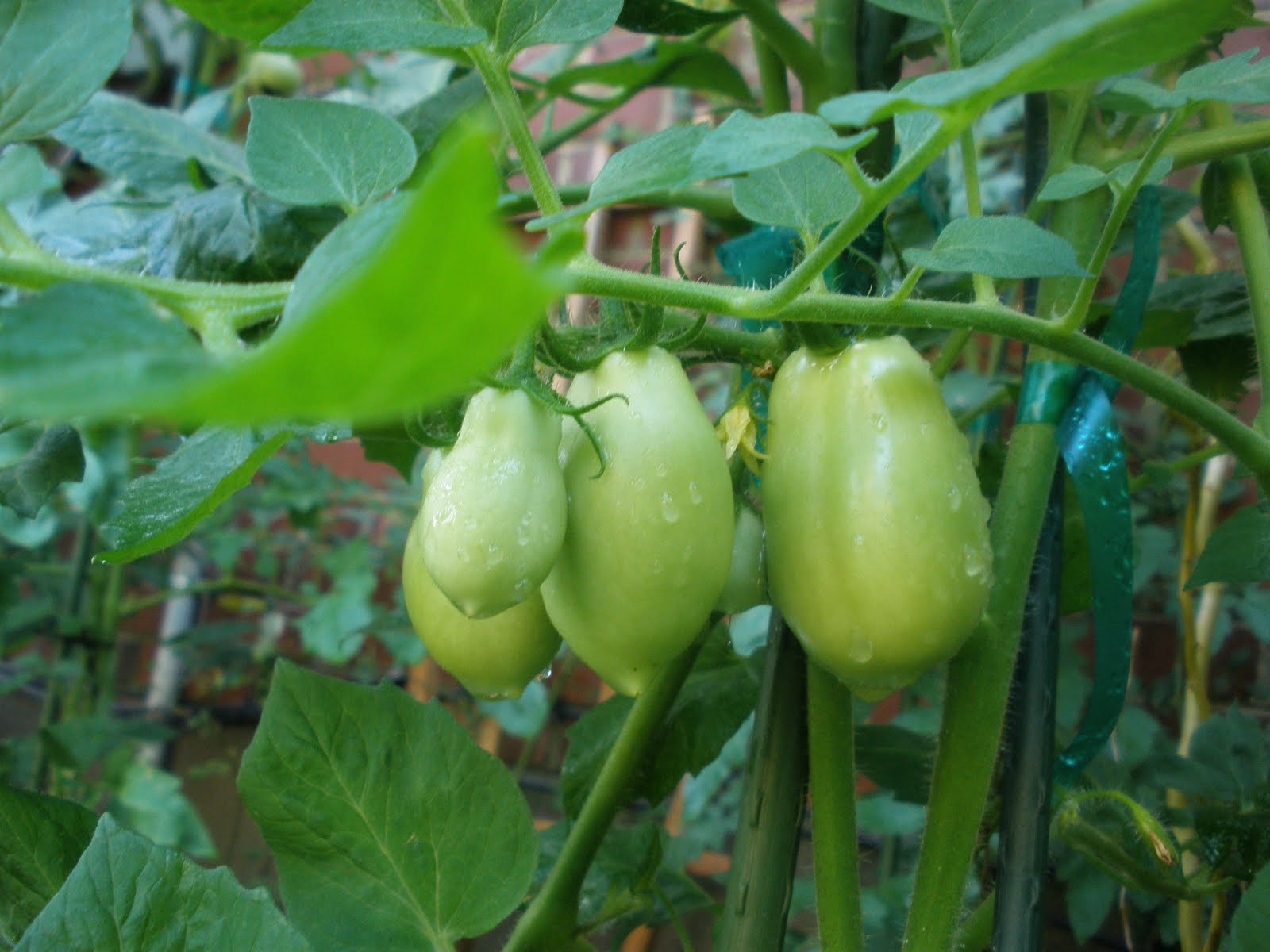
The tomatoes I have included in my garden thus far include Roma, ‘Black Cherry’, and ‘Big Boy’. Roma is a smaller tomato that should have a plentiful harvest starting in 70-80 days from transplanting. ‘Black Cherry’ is a sweet-flavored, round dark cherry tomato that should ripen within 60 days of transplanting. ‘Big Boy’ is a meaty, large hybrid introduced by Burpee in 1949. ‘Big Boy’ will ripen within 80-90 days from transplanting.

So, by the end of June, I should be harvesting the first tomatoes. I would still like to add an heirloom variety tomato and some more varieties of peppers. I have already planted one Jalapeno pepper which will ripen in 78 days.

Everything else in the garden is doing great. My Iris is now blooming very well by the mailbox, white and yellow blooms. The Baptisia and Peonies are about to bloom. My Azalea in the secret garden is blooming wonderfully.

The only pest problems I’ve had continue to be the aphids and ants on my Rose of Sharon. I used soap spray on them last week, but it has rained off and on since then so I don’t think it’s had a chance to work yet. I’ll keep trying the soap spray.

The photo is of my ‘herb garden’ container and some other perennial plant containers that I keep directly off my back deck. I'll probably add a petunia or million bells to the blue pot soon. But, I love all the different colors foliage and the pots themselves provide right now, without a single flower!

Thursday, April 15, 2010

a redneck garden


After moving to Nashville I kept hearing the term ‘Redneck Garden’. This term refers to an ornamental garden that includes edible plants normally associated with a vegetable garden. [I’ve chosen to ignore other components of said ‘redneck garden’, i.e. beer can wind chimes and the like] I’ll concede the idea was a foreign one to me, having grown up with a separation of ornamental and vegetable.

However, when you think about it, it really makes sense. I don’t know many people that have the space for fully separate ornamental and vegetable gardens, at least in an urban setting. Also, I think most people forget how aesthetically pleasing some veggies can be. Not to mention, growing your own vegetables saves money! So why not grow veggies in our flower beds?

I’m totally on-board and look forward to having my very own redneck garden soon. Just think of the positive consequences this idea could have if implemented in low-income ‘food deserts.’ We could all be eating better and/or more cheaply if we grew a few tomato plants in with our holly bushes, as an example.

The attached photo shows peppers grown alongside Salvia and Black-Eyed Susans. The color combination is phenomenal. I think I’ll achieve a similar effect planting veggies next to my Butterfly Bush and Black-Eyed Susans. Aesthetic benefits aside, growing some ornamentals like Marigolds with your tomatoes will actually prevent pests.

At the garden center this week I found a variety of herbs and vegetable starters available. For $15, I picked up Italian parsley, variegated Basil, a variety of Cilantro, and a Roma Tomato plant. Those herbs, along with the thyme and mint (and Rosemary) I already have will complete my herb ‘garden’ (which will actually be a pot to ensure good drainage).

The Roma tomato plant caught my eye because my boyfriend really likes Roma’s. But I’m also trying to grow several different varieties of tomatoes to hedge my bet that some will thrive. I should be able to plant all of these this weekend, and I’m still searching for more tomatoes and peppers to add.