Showing posts with label perennial. Show all posts

Wednesday, August 31, 2011

Blue mistflower: one of my favorites

Eupatorium coelestinum, blue mistflower, oh how I love you. You are unassuming, don’t ask for much, and yet you bloom for months on end. Your assertive nature is endearing and your lavender blue flowers look great with everything!

This plant is truly one of my favorite native perennials. When you see it in action on a hot August afternoon, it’s easy to understand why. This plant flourishes at a time of year when many perennials start to look weary.

In his revised ‘Garden Perennials’ Allan Armitage calls this Eupatorium “A terrific weed, much more tolerant of heat than most other members of the genus.” This cousin of the well-known Joe-Pye Weed grows about 2' tall and blooms summer through fall.

A word of warning, this plant is assertive (not aggressive). I’ve seen it spread by runners as well as by seed; new plants will pop up across gardens and driveways alike. While easy to weed, this is something to consider before planting.

Blue mistflower is a terrific bedding plant and does well in containers too. It is the perfect compliment to Sedona Coleus, Verbena bonariensis, and Sweet potato vine as shown in the above image. And if you can’t find any to purchase, I have some to share!

Monday, April 25, 2011

April showers...


April has been a busy gardening month. When I've been in town, I've been working in the garden planting more seeds and tomato starters. The carrots, lettuce, and swiss chard have all sprouted and the Iris and Columbines have begun to bloom (and they make terrific cut flowers!).

As expected, I've had to spray the hibiscus with soapy water for black aphid control, which seems to have worked well. We’ve received lots of rain (which I’m now tracking on my newly installed rain gauge) which has helped the veggies (and weeds) grow. I need to install a support for the sweet peas and do some more weeding.

I’ve spent two weekends in Knoxville this month and enjoyed the Dogwood Arts trail and local garden centers. The picture above is a peony from one of the Dogwood Arts Festival’s open gardens. Last weekend my mom and I went to Mayo’s and I found two of the heirloom tomato varieties I’ve been looking for; they had a fantastic selection.

So far, the tomatoes I’ve purchased (and planted*) include: Early Girl*, Black Cherry*, Yellow Pear*, Cherokee Purple, and Black Krim. Early Girl is a hybrid red tomato grown for early harvesting (June). Black Cherry is a tiny black/purple tomato that I had success with last year.

Yellow Pear is another cherry tomato variety. I’ve never grown this variety before but I’m eager to taste test, as some tomato eaters prefer yellows. I’ve also never grown Cherokee Purple or Black Krim before, which are both large dark red/burgundy heirloom varieties.

A Roma (for homemade pizzas) and maybe a red beefsteak will round off my tomato acquisitions for the year. I’m also looking to purchase hot and sweet peppers, and more herbs including tarragon, sage, and oregano. The goal: to grow as much of my own produce and herbs as possible.

Friday, February 25, 2011

Only 23 Days 'til Spring!


Currently, there are several blooming plants in the garden: Witchhazel, Hellebore, Forsythia, and Daffodil! What’s interesting is that three of these four bloomers are yellow. I happen to like yellow, think it’s a fresh and exciting color. But you may be surprised that in talking to clients, it’s one of the least favored flower colors.

Some of the Witchhazel (Hamamelis) varieties are still blooming and the fragrance is quickly becoming one of my favorite. It’s a sweetness tinged with citrus that makes you literally stop in your tracks to take in the aroma, delightful!

The Hellebores started blooming this week, and that show will go on for months. One of my favorite perennials, this plant is a real trooper. I went through and clipped out any tired-looking foliage, which made the flowers stand out even more. My hellebores are lavender blooming, but I love the white and speckled varieties just as much.

Forsythia is a great shrub to use en masse, if you have a large area to devote to them. But more often then not, they are (over) planted in small areas and pruned incorrectly. What results is a boxy-looking shrub with sparse flowers. This plant will grow 10’ tall and needs delicate pruning immediately after flowering to ensure a good show next year.

Rijnveld’s Early Sensation Daffodil (Narcissus) is the earliest hardy daffodil to bloom. It is classified as a trumpet daffodil, which means it has one of the larger blooms of the species. The two-toned yellow blooms stand about 12” tall, and will keep blooming despite any future blankets of snow.

There’s only 23 more days until spring, let the count down begin!

Monday, January 31, 2011

first blooms of 2011!


As big snowflakes flurried around Nashville this morning, I saw the first signs that spring is in fact right around the corner…daffodils peeking through the soil! It will still be several weeks before they bloom, but it is exciting nonetheless. Today I was also greeted by the first bloom of 2011, Witchhazel (Hamamelis vernalis).

Witchhazel is a beautiful large shrub of which there are several native varieties. Landscape features include gorgeous yellow fall color and pungently fragrant yellow/orange flowers in late winter. This is a great shrub for massing in the back of a naturalized border planting. “A tough plant with an alley-cat tenacity” says woody plant expert, Dr. Dirr.

Another plant on my bloom watch list is the Lenten Rose (Helleborus). Speaking of Lenten Rose, the person who introduced me to that amazing perennial, Dr. Allan Armitage has revised Armitage’s Garden Perennials. The new version will be out this summer and is a must-have book for any perennial gardener.

Last weekend I took advantage of extraordinarily mild temperatures to finish cutting back all remaining perennials and mulching a few of the planting beds. Working in the garden, I noticed how graceless my large butterfly bush has become. I’m going to have to cut it back and remove a lot of water sprouts before it leafs out.

[Water sprouts are vigorous growths along a branch that grow almost vertically and are aesthetically displeasing.]

This time of year can be down-right depressing with grey days and freezing temperatures. Knowing that spring will soon be here provides some relief from winter doldrums. Until then, I will keep thumbing through garden catalogues and dreaming of warmer days and the beautiful blooms to come!

Tuesday, December 28, 2010

Garden Year In Review


It has been months since I blogged about my garden so there’s lots to catch up on; and I thought I would review this year’s garden successes and failures. By all accounts, I was far more productive in 2010 than I had been in previous years. I may not have weeded as much as I could/should have, but I had a modicum of success with the hollyhocks, veggies, and herbs. Also, I hope to have some quality compost to add to the garden at the start of the next growing season.

Into the fall we enjoyed tomatoes, peppers, and fresh herbs. I definitely plan on growing Romas and Cherry tomatoes again, but I may look into other beefsteak and heirloom varieties since Big Boy and Mr. Stripey didn’t perform as well. Although by all accounts, this was a difficult year for growing tomatoes in my area. The unseasonably hot nights prevented the tomato flowers from pollinating and ergo many folks had smaller yields this year.

My tomato staking system worked well; at one point all of the tomatoes were taller than me and I had to attach them to nearby shrubs and walls for support. Just before the first hard frost, I harvested all of the remaining (green) tomatoes and brought them inside to ripen. We had home grown tomatoes ripening for almost two months after that!

I plan on growing more peppers, especially more hot peppers next season. The jalapenos were very successful. I may try my hand at a few other varieties including Serrano, Poblano, and Banana peppers too. The red peppers fruited so late that I wasn't able to harvest a red pepper, instead I plucked the ripening (green)peppers off the plants and made stuffed peppers with them. All of the homegrown peppers proved far superior to their store-bought counterparts.

The last of the parsley was harvested two weeks ago, as it was snowing; and I'm frequently cutting sprigs of fresh rosemary for various recipes. Next year I will keep cilantro seeds around to plant every few weeks as they will inevitably bolt before I’m able to make my homemade guacamole. Thanks little sis for my new mortar and pestle!

This fall’s garden maintenance mainly consisted of cutting back all perennials, veggies and taking out the tomato and pepper supports. This was made slightly more cumbersome by the mesh fencing I installed mid-growing season. Using two of my favorite garden accessories, West County waterproof gloves and Felco pruners, this task took about fifteen minutes.

[It’s important to note that like rose clippings, tomato plant refuse shouldn’t be composted because there is a high likelihood of diseases outliving the composting process. I have decided to burn such debris in our fire pit.]

The reason the West County gloves are worth mentioning is that not only are they waterproof and washable, they’re warm. It is still easy to grasp things and do slightly detailed garden work year round. Also, the insulating material makes pruning tasks blister free!

The Felco’s are garden essentials and with proper cleaning and sharpening should last a lifetime; all parts are replaceable. The ergonomic Felco 6’s fit my petite hand very well and are the best pruners I have ever used. This size easily cuts through branches 3/4" thick. But one should be careful, they are very sharp and powerful; I have inadvertently cut through a small rock with these pruners before.

I have daffodil bulbs to plant if I could find the time when the ground wasn’t frozen. October through December is the best time to plant spring-blooming bulbs. The two varieties I have to plant are ‘Ice Follies’ and ‘Mount Hood’. 'Ice Follies' is a large white daffodil with a bright yellow center. 'Mount Hood' opens up a pale yellow, and then quickly becomes an all white giant trumpet. Both of these naturalize readily and perform well in the south.

Typically, I like to see daffodils planted in large swaths (anywhere from 500-1500) to create a bold statement in the spring. Since my gardening area is so small, I will be planting mere handfuls of them here and there. Van Engelen is an economical source for large quantity orders; another daffodil source I use is Brent and Becky's Bulbs.

Wednesday, June 16, 2010

tall tomatoes and such


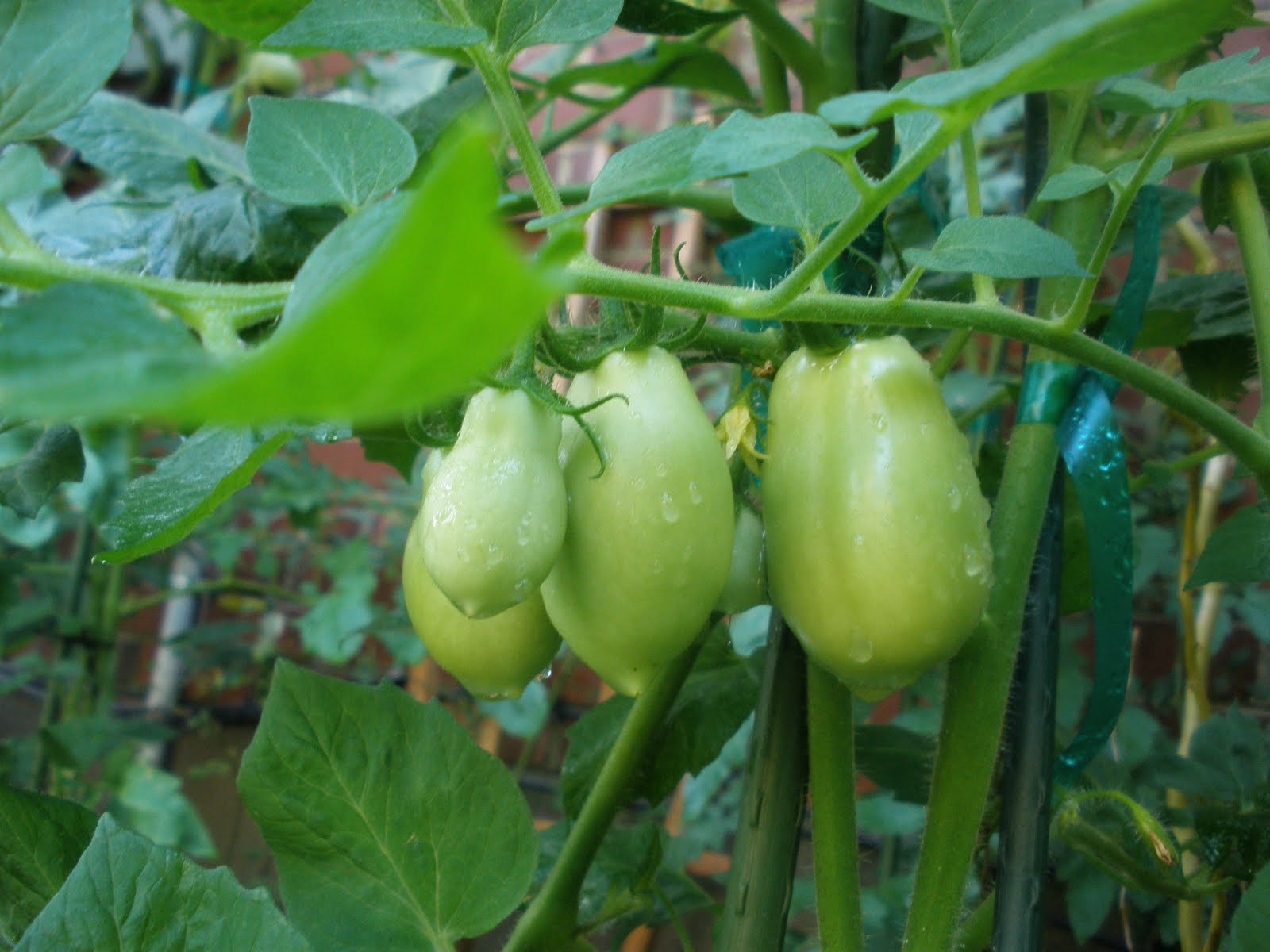
Now my tomatoes are taller than me, 5'-5". Well Big Boy and Black Cherry are at least, with Roma (pictured) right behind. Mr. Stripey had a later start and I’ve even relocated him once so I’m not surprised his growth is dwarfed by the others. I may have to buy several more, larger stakes to secure the three larger tomatoes, which continue to reach for the heavens.

The three large tomato plants all have multiple baby tomatoes that grow larger and more numerous everyday. I need to prune out some of the excessive foliage and suckers ASAP. And, I have a baby jalapeƱo! So far, however, that’s my only pepper.

I won’t be posting photos of my herb pot anytime soon, it has seen better days. The thyme is doing great and the parsley is fine, the variegated basil even looks to be making a comeback. But the cilantro has ‘gone to seed’ and looking worse each day. I’m hoping I’ll be able to harvest some coriander, but I’m not holding my breath.

I have planted a new basil plant and hope to add others as I count more tomatoes everyday! The Rosemary is doing great and has probably doubled in size since I planted it earlier this year. And the mint is going gangbusters, taking over the driveway planting bed.

Also in the driveway planting bed, the last remaining Hollyhock flower buds are blooming. Still all white! And the Rose of Sharon (pictured) has begun to bloom! I have counted only two blooms so I’m hoping for more. It is one of my all-time favorite flowers; admittedly this may be because they remind me of my grandparents, but nonetheless, gorgeous.

Back across the drive, in the west side planting bed, the Black-eyed Susans have begun to bloom. They will look great alongside the pinkish reds of the sedums and daylilies close by. Along with the tiger lilies, the pink/red, orange, yellow combination is actually quite lovely.

Also, I have discovered that a beloved annual, Verbena bonariensis, has reseeded itself. While not the most ideal location (in the front of the flower border), it’s a welcome surprise! This annual has rose purple flower clusters at the end of slender square stems growing 4’ or more in height.

I prefer this plant in the back of the flower border, and often pinch it back a few times to induce a more compact habit. Once it starts blooming, you will have color on into the fall. Another benefit is this plant attracts butterflies and gold finches. The only downside is an occasional powdery mildew episode; if this occurs, I just cut back all affected foliage.

And finally, a favorite perennial planted on the bank at the rear property line, the evening primrose (Oenothera), has begun to bloom! I don’t know much about this plant, but I’m delighted that it seems to have spread and I now have at least twice as many plants as last year. [I believe it spreads by seed, because one popped up in a nearby pot.]

I’m amazed that this inconspicuous plant has thrived where it has, competing with the likes of ivy and euonymus. As the name suggests, swirls of buttery yellow blooms open up after the sun goes down. It’s great in combination with the tiger lily; especially since they both bloom at a height of 3-4’. The flowers are truly beautiful, and the perfect crescendo to a summer day.

Tuesday, June 8, 2010

the tiger lily: a welcome volunteer


Now the tiger lilies (Lilium) are blooming! A native of Asia, this plant has naturalized ditches and hillsides all over North America. I am happy to welcome it in my garden, though I keep it restricted to the very back of my west side border. It also is sprinkled all over the bank at the rear property line, where it receives no maintenance from me.

The beautifully detailed orange bloom stands tall, at about 3 ½ feet. The foliage is a medium green and looks similar to that of the Daylily. It is a nice transition between the spring and summer blooming flowers and the color complements most any other flower in the garden. These volunteers can be aggressive, and seem to spread by underground rhizomes.

Because of the foliage, and the name ‘Lily’, I had assumed that this plant was a cousin to the Daylily (Hemerocallis). After my experiment, however, I’m thinking that’s about all they have in common. Daylilies make a poor choice for the cut flower garden, with blooms lasting only a day (hence the name). I wondered how the tiger lily would do as a cut flower…

I was already cutting back some of my Baptisia to make more room for the veggies when I realized how nicely the Baptisia foliage complimented the Tiger Lily bloom. So I grabbed a vase and cut off a stem of Tiger Lily flowers and buds and added the Baptisia fronds. Instantly, I liked the combination, but knew it probably wouldn’t last.

To my surprise, the Baptisia leaves still look great, nearly a week later. The Tiger Lily flowers and buds continued to bloom for days (the blooms close up at night). It ended up being a great, long-lived cut flower combination!

[The photo on the pavement was the initial arrangement, and the photo on the deck was taken after several days.]

Wednesday, April 14, 2010

Ants and things


Things are growing great in the garden. I spent some time last weekend weeding several beds and trying to ‘thin the heard’ of mint, creeping jenny, and sedum. Would anyone like to come over and take home a sampling of these voracious ground covers?! I also mulched a little and amended the soil for the Hollyhocks which I will be planting this week!

The Hellebores are still blooming. The Rosemary is blooming now, pretty little blue flowers. The Peonies, Baptisia, and Iris will all be blooming soon. My Epimediums are now blooming in my side shade garden (picture). That’s a really neat perennial for the shade garden. They are also commonly referred to as Barrenwort and Bishop’s hat.

Epimediums are grown as much for their flowers as they are for their heart-shaped foliage which can take on beautiful fall coloring. Their tiny flowers are suspended ever so gracefully on their arching flower stalks. Epimediums make great accent plants and groundcovers, although they die back almost completely in our zone. I like to pair my yellow blooming Epimediums with purple-leaved plants like Ajuga and Heuchera.

I recently discovered ants on some of my Rose of Sharon. I fear the ants are ‘milking’ aphids which in turn are feasting on the new foliage. This morning I sprayed the bugs off with water, let’s hope that keeps them away. My next approach may be to use a soap spray. I generally try to avoid using any chemicals in the garden, but especially now that I’m growing edible plants, that would be my last resort.

There are ants on my Peonies as well, which are across the driveway. I have come to expect this every year on the Peonies. [Although at first it was alarming and I admit I sprayed my Peonies with ant killer chemicals that first year] A very knowledgeable gardener explained to me that ants help the Peony buds ‘open up’. So now I ignore the ants, and my peonies have never suffered because of them.

Thursday, March 25, 2010

longer days, more gardening adventures


Last Saturday I worked in the garden until after sunset, which now is almost 7:00! Thanks, Daylight Savings Time. I weeded, planted, divided, relocated, mulched, and watered. I worked mainly in the planting bed on the west side of my house (picture). With almost due west exposure, this bed gets the most sun of any of my planting beds and eventually this bed will be home to my future tomato plants.

An early goal of mine was to screen the a/c unit on the left and for that, I choose Euonymus 'Green Spire'. [Normally, I am NOT a proponent of Euonymus in general, but these plants look pretty good all year, are very cheap, and as far as I know will not become invasive.] The Euonymus hedge has been planted for a few years now with an initial investment of less than $50.

In front of the Euonymus hedge are ornamental grasses (still dormant), and a new patch of sedum that replaces the Black-eyed Susan’s (Rudbeckia) that I just relocated to elsewhere in the bed. The large shrub, butterfly bush (Buddleia davidii), which now reaches the top of the brick wall, is a personal favorite. In fact I plan to do another blog post specifically about this plant.

In front of the butterfly bush is Lambs Ear (Stachys byzantina). I believe I have the variety called ‘Big Ears’. This is a neat perennial with silver-green foliage and I can’t help but feel the soft leaves every time I’m nearby, they really do feel like lambs ears. In between the butterfly bush and lambs ear are my beloved peonies (which are just now starting to poke through the soil).

You can barely see the corkscrew willow (Salix matsudana) under the electric meter. This is a very cool, graceful plant with an extremely fine textured, medium-green leaf and yellow bark. Between it and the butterfly bush is my recently planted climbing rose (no clue what variety). There is a small trellis for the rose now, but I will probably run some wire for it to climb on this summer. The climbing rose takes the place of another butterfly bush, which I cut back and relocated to the planting bed across the driveway.

Near the middle of the bed, there’s a medium green groundcover that has basically taken over this portion of the planting bed. As of yet, this Sedum has remained unidentifiable. I have probably 10 different sedums growing throughout my various planting beds; they’re great low-maintenance perennials that come in a variety of foliage and flower colors (I’m a huge fan). But this one grows faster than any I’ve ever encountered. I’ll probably remove portions of this to make room for my tomatoes!

The blue pot will eventually be planted with herbs and/or seasonal color, and probably won’t remain in the bed. Behind the pot, against the house are a row of tiger lilies (Hemerocallis fulva), which will bloom creamsicle-orange. This plant is also fondly called ‘ditch lily’, and is a fine example of what I call a ‘native invasive’.

In the right corner of this bed is a newly planted upright rosemary, although the variety name escapes me now. I’m so excited about this rosemary and once it fills out (about 4’ tall) I think it will really help to anchor the space. My kitchen door is right around the corner, and I’m looking forward to using this herb while cooking!

Behind the rosemary is a patch of Pachysandra terminalis ‘Green sheen’. It’s an amazingly care-free evergreen groundcover, probably deserving of its very own blog post. Pachysandra has beautiful shiny dark green leaves of a medium texture. While no one buys this plant for the bloom alone, the dainty clusters of white flowers are quite nice; mine are in bloom right now!

This is my favorite planting bed because of the variety of foliage and bloom colors that all work so well together. I’m also really pleased with the year round presence the pachysandra, euonymus, butterfly bush, lambs ear, sedum, and now rosemary will provide. But in the summer, this bed literally comes alive with all of the warm flower colors of plants that haven’t even come up yet.

Throughout the bed are Black-eyed Susan’s (Rudbeckia), Tennessee Coneflower (Echinacea tennesseensis), other sedums, and various daylilies (from my uncle). I’ll take pictures along the way to document the bloom/growth progress. Bottom line, the garden doesn't look like much now, but i promise, an amazing transformation is in the works!

Wednesday, March 17, 2010

a good day to be GREEN


Spring is upon us. Everyday, driving around town, I notice the new blooms of daffodils, crocus, cherry trees, and witch-hazel. But the only thing blooming in my garden right now is Helleborus orientalis, the Lenten Rose. This is one of my favorite perennials. It is beautiful, evergreen, versatile, durable, hardy, and above all else, extremely low-maintenance. What more can you ask for in a perennial?

I was first introduced to this awesome plant by Dr. Allan Armitage, while a student at UGA. He is one of the foremost perennial plant experts and a big proponent of Hellebores. While I call most plants by their botanical (genus) names, it is rare that most people (non-horticulture-types) would do the same. The Hellebore, I’ve found, is one of the exceptions to this rule. Another interesting thing about Hellebores is that the blooming part of the plant is not actually a ‘flower’ or ‘petals’ at all, rather they are sepals, or modified leaves.

There are generally two species of Hellebores available at retail garden centers: Helleborus orientalis (Lenten Rose), and Helleborus foetidus (Stinking Hellebore). Helleborus orientalis is the only one in my garden, so that’s what I’m talking about when I say ‘Hellebore’. However, H. foetidus is a lovely perennial in its own right with many of the same characteristics, but having finer leaf texture. [Also, I don’t find that it particularly smells bad and I’m afraid its common name may turn people away from a perfectly good plant.]

An evergreen perennial, Hellebores can form clumps of dark green, coarse foliage with blooms reaching 18”. There size increases over time, but I generally think of them as 12” tall perennials. Hellebores do well in full shade and full sun. However, the best balance of foliage and blooms probably occurs in a partial shade environment. Full sun exposure produces prolific blooming, but can scorch the edges of leaves. Hellebores will become quite drought tolerant once established, but prefer regularly moist soils.

Obviously there is a connection between the common name and the bloom time, Lent. It’s a great time to have something blooming in the garden since everyone I know is incredibly anxious for spring right now. Hellebores do not have very showy flowers, but the bloom is so beautiful and intricate, I find myself on hands and knees trying to get a better look. The true species has a creamy white-pink bloom that faces slightly downward and can have darker-hued splotching or fading on the interior of the sepals.

Hellebores have been cross-bred so many times that there is a kaleidoscope of color options to choose from. Blooms range from white, green, pink, purple, and everything in between. Sometimes there will be different colored-blooms on the same plant. Newer hybrids have created more compact and upright blooming varieties such as ‘Ivory Prince’, which is becoming very popular in the trade. The Hellebores in my garden bloom shades of pink, from rosy-pink to a purple-pink, the richness of which is hard to find elsewhere. Although gorgeous, this darker color does not stand out in the garden as well as the lighter blooming varietals.

I use Hellebores in my garden as accents in the perennial border alongside ferns, epimediums, and gingers. But they can make excellent groundcovers as well. They are highly effective when planted en masse for a bold flower display in late winter and a carpet of lush foliage throughout the year. The only maintenance I perform is occasionally removing scorched leaves in late summer/fall and spring fertilization when I fertilize the planting bed, that’s it!

I’ve been told (and have witnessed this in Dr. Armitage’s garden) that hellebores reproduce from seed eagerly. I have not yet experienced this in my own garden, but I remain hopeful; mainly because they are one of the more expensive perennials to purchase. Hellebores are native to Europe and Asia, but they will not displace our native species, so I advise planting as many as possible if you like what you read. I find Hellebores available for purchase year-round but I suggest buying them now, so you can see the flower color.

On a side note, the 6 Hollyhock seedlings are still surviving in the greenhouse and at least 3 plants appear to have over-wintered in my garden. This would be reason enough to celebrate but lucky for me it’s also St. Patrick’s Day! Happy Gardening!

Monday, March 8, 2010

the Greek word for Rainbow


This past weekend brought us beautiful spring weather and I was able to spend about an hour working in the yard on Saturday. The area I focused on is the small perennial bed next to my mailbox at the street. This planting bed sits at the start of a swale that runs along the front of my property parallel to the street. It’s an odd sort of depression that’s difficult to mow; from day one I envisioned a sinuous planting bed of perennials and shrubs to replace the grass in the swale and provide a colorful front border for the house.

Several years ago I was renovating my grandfather’s Iris bed in Knoxville and the process of dividing his Iris yielded several mulch bags filled with rhizomes. The flower takes its name from the Greek word rainbow, referring to the wide variety of flower colors available in the genus. Now I know that the Iris I planted bloom yellow and white. But at the time I planted my rhizomes, I had no idea what I might end up with.

Iris prefer full sun to bloom well, and they can grow very tall. I have seen some flower spikes reach 3-4’ in height. At the time I didn’t have a spot that I thought would work well for the Iris, so I decided to start my ‘swale’ planting bed. Turning a patch of grass into a planting bed is HARD work; when your lawn is comprised of Bermuda grass, it’s even harder.

I added a few daylilies to the front of the bed as well, given to me by my day-lily breeding uncle. The effect is quite nice with blooms from spring through summer. They actually bloomed well the first year, which was surprising. They had a good year last year, but I didn’t keep up with weeding very well. That’s why I pulled out two garbage bags of weeds (for the composter). Then I cut each Iris fan back to three or four inches from the ground. That is a maintenance task best performed in the fall, but I suppose it’s better late than never.

Next I’m going to mulch the bed with soil conditioner. Most Iris growers do not recommend mulching, because the rhizomes can rot so easily (especially in our humid climate). But I think a light top-dressing of soil conditioner improves the soil and looks really good. I’m still debating whether or not to fertilize this area since I don’t want to give the grass (weeds) a head start. Regardless, I’m looking forward to better maintaining the area and lots of blooms this year.

The attached picture was taken in 2008, and I sent my grandfather a copy of it. After my grandfather passed away last summer, I found this picture framed in his bedroom. Every time I see the Iris blooming, I think of him and his love of gardening.

Thursday, February 18, 2010

to everything, there is a season


At work yesterday, I was elated when I caught a glimpse of the first signs of spring…daffodils coming up! It’s easy to think after 3 weeks of snow on the ground that we will forever be stuck in winter. But with those spikes of perennial daffodil foliage, we are reminded once again that even winter comes to an end. And with that end comes the promise of spring blooms!

This particular outcropping of white and pale yellow daffodils lies under a small grouping of reddish-pink blooming redbud trees, with the mulch path to the greenhouse running right through them. It’s an incredible combination of spring blooms.