Showing posts with label plant combinations. Show all posts

Friday, March 18, 2011

fall planted bulbs are abloom!


I don’t need a calendar to tell me it is spring. With temperatures in the 70's, there are new blooms to enjoy every day. Among my favorite flowers right now are crocus, grape hyacinths, daffodils, and my favorite deciduous magnolia, the Saucer Magnolia (Magnolia x soulangiana).

Perennial Crocus grow from corms (like a small bulb) planted in the fall. Their grass-like foliage and petite flowers won’t grow taller than 5”, so use them in the front of a planting bed. The white and purple varieties nicely offset the electric orange central stigmas. The spice saffron is obtained from the fall-blooming cousin of this plant (Crocus sativa).

Grape Hyacinths (Muscari) received their name from the spikes of blue flowers that resemble a bunch of grapes. This perennial, grown from a bulb planted in the fall, is even more petite than the Crocus. It’s perfect companion is a yellow daffodil, King Alfred for example, planted in alternating clumps/drifts.

Despite it’s observed commonness, the Saucer Magnolia is truly a thing to marvel. I first noticed this tree while going to school in Athens, Georgia. One specimen in particular (pictured in Dirr’s Hardy Trees and Shrubs) located out front of the AGD house on fraternity/sorority row is particularly memorable.

Its canopy of tulip-like pinkish-purple flowers is “one of spring’s greatest spectacles” according to Dr. Dirr, and I’m inclined to agree. This deciduous magnolia is a real show-stopper, with an attractive multi-trunked habit. But, since it’s just a one season wonder, I would plant this only as a specimen or focal point of a spring garden and not in a group.

This weekend marks seed planting time for my lettuce, carrots, and Swiss Chard! Another landscape project I hope to start is installing a stone border that wraps around all the planting beds against the house. Aside from aesthetic benefits, the border should also help slow the spread of Bermuda grass into the planting beds.

And speaking of grasses, if you haven't already cut back landscape grasses such as River Oats (Chasmanthium), Sioux Blue Indian Grass (Sorghastrum), Sweet Flag (Acorus) et cetera, do it now, before the new shoots emerge!

Wednesday, June 16, 2010

tall tomatoes and such


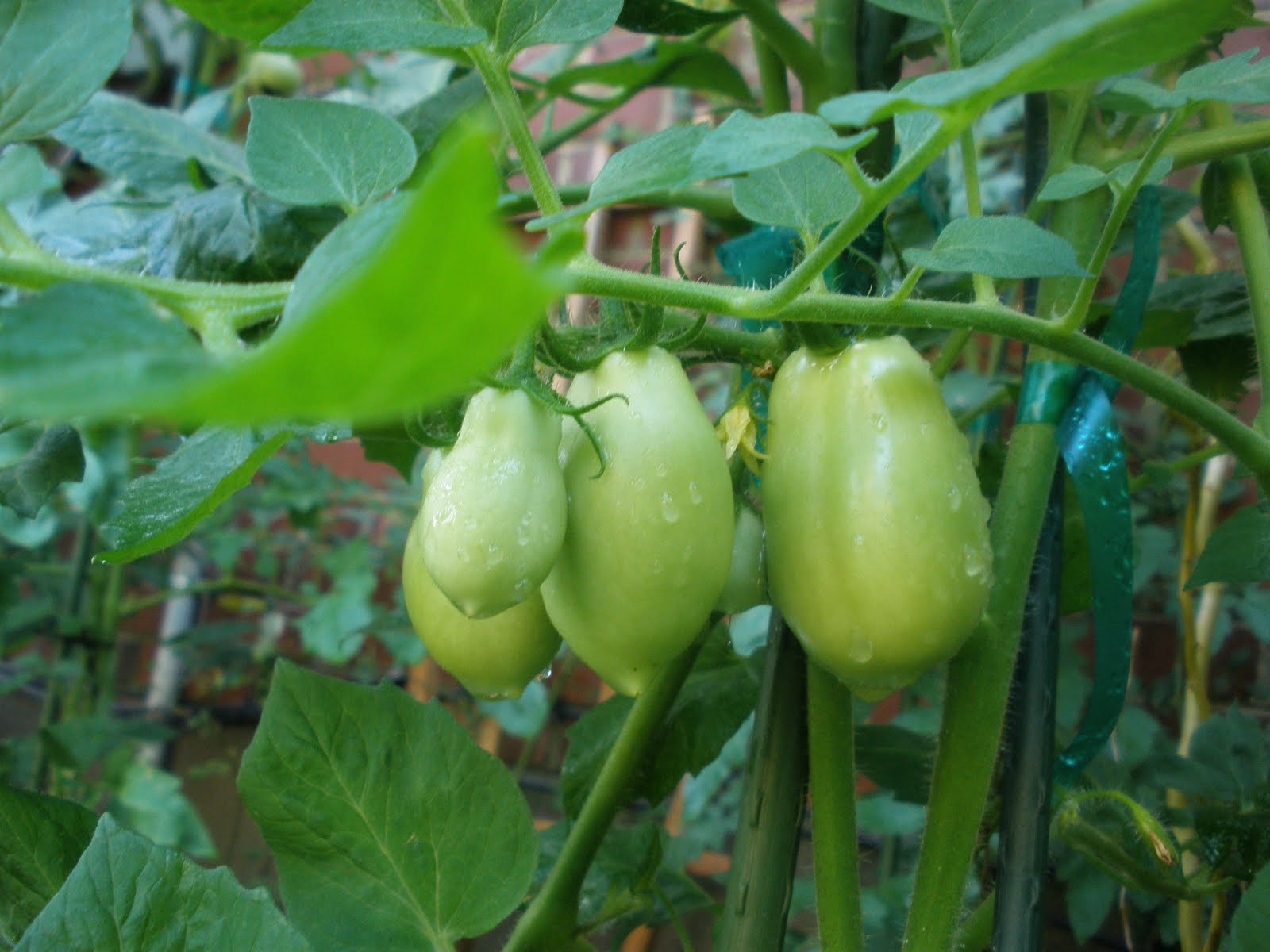
Now my tomatoes are taller than me, 5'-5". Well Big Boy and Black Cherry are at least, with Roma (pictured) right behind. Mr. Stripey had a later start and I’ve even relocated him once so I’m not surprised his growth is dwarfed by the others. I may have to buy several more, larger stakes to secure the three larger tomatoes, which continue to reach for the heavens.

The three large tomato plants all have multiple baby tomatoes that grow larger and more numerous everyday. I need to prune out some of the excessive foliage and suckers ASAP. And, I have a baby jalapeƱo! So far, however, that’s my only pepper.

I won’t be posting photos of my herb pot anytime soon, it has seen better days. The thyme is doing great and the parsley is fine, the variegated basil even looks to be making a comeback. But the cilantro has ‘gone to seed’ and looking worse each day. I’m hoping I’ll be able to harvest some coriander, but I’m not holding my breath.

I have planted a new basil plant and hope to add others as I count more tomatoes everyday! The Rosemary is doing great and has probably doubled in size since I planted it earlier this year. And the mint is going gangbusters, taking over the driveway planting bed.

Also in the driveway planting bed, the last remaining Hollyhock flower buds are blooming. Still all white! And the Rose of Sharon (pictured) has begun to bloom! I have counted only two blooms so I’m hoping for more. It is one of my all-time favorite flowers; admittedly this may be because they remind me of my grandparents, but nonetheless, gorgeous.

Back across the drive, in the west side planting bed, the Black-eyed Susans have begun to bloom. They will look great alongside the pinkish reds of the sedums and daylilies close by. Along with the tiger lilies, the pink/red, orange, yellow combination is actually quite lovely.

Also, I have discovered that a beloved annual, Verbena bonariensis, has reseeded itself. While not the most ideal location (in the front of the flower border), it’s a welcome surprise! This annual has rose purple flower clusters at the end of slender square stems growing 4’ or more in height.

I prefer this plant in the back of the flower border, and often pinch it back a few times to induce a more compact habit. Once it starts blooming, you will have color on into the fall. Another benefit is this plant attracts butterflies and gold finches. The only downside is an occasional powdery mildew episode; if this occurs, I just cut back all affected foliage.

And finally, a favorite perennial planted on the bank at the rear property line, the evening primrose (Oenothera), has begun to bloom! I don’t know much about this plant, but I’m delighted that it seems to have spread and I now have at least twice as many plants as last year. [I believe it spreads by seed, because one popped up in a nearby pot.]

I’m amazed that this inconspicuous plant has thrived where it has, competing with the likes of ivy and euonymus. As the name suggests, swirls of buttery yellow blooms open up after the sun goes down. It’s great in combination with the tiger lily; especially since they both bloom at a height of 3-4’. The flowers are truly beautiful, and the perfect crescendo to a summer day.

Tuesday, June 8, 2010

the tiger lily: a welcome volunteer


Now the tiger lilies (Lilium) are blooming! A native of Asia, this plant has naturalized ditches and hillsides all over North America. I am happy to welcome it in my garden, though I keep it restricted to the very back of my west side border. It also is sprinkled all over the bank at the rear property line, where it receives no maintenance from me.

The beautifully detailed orange bloom stands tall, at about 3 ½ feet. The foliage is a medium green and looks similar to that of the Daylily. It is a nice transition between the spring and summer blooming flowers and the color complements most any other flower in the garden. These volunteers can be aggressive, and seem to spread by underground rhizomes.

Because of the foliage, and the name ‘Lily’, I had assumed that this plant was a cousin to the Daylily (Hemerocallis). After my experiment, however, I’m thinking that’s about all they have in common. Daylilies make a poor choice for the cut flower garden, with blooms lasting only a day (hence the name). I wondered how the tiger lily would do as a cut flower…

I was already cutting back some of my Baptisia to make more room for the veggies when I realized how nicely the Baptisia foliage complimented the Tiger Lily bloom. So I grabbed a vase and cut off a stem of Tiger Lily flowers and buds and added the Baptisia fronds. Instantly, I liked the combination, but knew it probably wouldn’t last.

To my surprise, the Baptisia leaves still look great, nearly a week later. The Tiger Lily flowers and buds continued to bloom for days (the blooms close up at night). It ended up being a great, long-lived cut flower combination!

[The photo on the pavement was the initial arrangement, and the photo on the deck was taken after several days.]

Thursday, May 27, 2010

bugs are gone!


The ant/aphid infestation on my Rose of Sharon is completely gone. And since spraying my hollyhocks with Sevin I haven’t seen any more hollyhock sawfly larvae chomping away. They still haven’t bloomed, but I’m hopefully every day when I come home from work to catch a glimpse of color.

Last weekend I removed a portion of my Black-eyed Susan’s in the west side planting bed to make room for two more pepper plants and give my rosemary some more space. In addition to the new red and green bell peppers, I also planted an heirloom tomato in the driveway planting bed. I’m hoping it will get enough sun there, because I’m running out of space elsewhere.

Mr. Stripey, as he’s called, is an old-fashioned beefsteak that will have yellow and red stripes outside and mostly yellow coloring inside the fruit. It has tiny leaves and the flavor is supposed to be sweet and mild. We’ll see in approximately 56 days!

I think I initially underestimated the support my tomatoes would require. But now I regret skimping on the stake size, because my ‘big boy’ and ‘black cherry’ tomatoes have already grown almost to the top of their stakes. So, I will have to purchase taller/stronger stakes to support these veggies and re-tie all of the tomatoes. Bummer.

I also (finally) replaced the pansies in my pots by the front steps with a ‘lemon chiffon’ million bells (Calibrachoa) in each pot. I’m not usually one for monochromatic pot plantings, but my front door is hardly used and there’s enough going on in the nearby planting beds to warrant simple pots.

My oakleaf hydrangea (Hydrangea quercifolia) have started blooming on both sides of the front door and look really great behind my patch of catmint (Nepeta) to the right of the front door. To balance that, the Nepalese columbines I planted on the left side of the front door bloomed well and are slowly taking over one side of that planting bed.

The Hellebores are still blooming and look great next to the sensitive ferns (Onoclea sensiblis) out front. My Iris have finished blooming and I need to weed the bed by the mailbox to get it ready for the daylilies which will start to bloom soon.

The only other annual I have added this season is a ‘Mini Blue-Veined’ Supertunia. I added this to my blue pot with the Salvia and Spirea. The salvia has already started blooming and the Spirea will soon follow.

My herb pot is not looking so good. The cilantro started to bolt last week, so I cut off some of the flower buds. The basil, which has been looking ill ever since the floods, now looks awful. My parsley and thyme are the only things doing well. They seem to have had good drainage and decent sun where they are. I may have to start over with new cilantro and basil, maybe even from seed.

Thursday, April 15, 2010

a redneck garden


After moving to Nashville I kept hearing the term ‘Redneck Garden’. This term refers to an ornamental garden that includes edible plants normally associated with a vegetable garden. [I’ve chosen to ignore other components of said ‘redneck garden’, i.e. beer can wind chimes and the like] I’ll concede the idea was a foreign one to me, having grown up with a separation of ornamental and vegetable.

However, when you think about it, it really makes sense. I don’t know many people that have the space for fully separate ornamental and vegetable gardens, at least in an urban setting. Also, I think most people forget how aesthetically pleasing some veggies can be. Not to mention, growing your own vegetables saves money! So why not grow veggies in our flower beds?

I’m totally on-board and look forward to having my very own redneck garden soon. Just think of the positive consequences this idea could have if implemented in low-income ‘food deserts.’ We could all be eating better and/or more cheaply if we grew a few tomato plants in with our holly bushes, as an example.

The attached photo shows peppers grown alongside Salvia and Black-Eyed Susans. The color combination is phenomenal. I think I’ll achieve a similar effect planting veggies next to my Butterfly Bush and Black-Eyed Susans. Aesthetic benefits aside, growing some ornamentals like Marigolds with your tomatoes will actually prevent pests.

At the garden center this week I found a variety of herbs and vegetable starters available. For $15, I picked up Italian parsley, variegated Basil, a variety of Cilantro, and a Roma Tomato plant. Those herbs, along with the thyme and mint (and Rosemary) I already have will complete my herb ‘garden’ (which will actually be a pot to ensure good drainage).

The Roma tomato plant caught my eye because my boyfriend really likes Roma’s. But I’m also trying to grow several different varieties of tomatoes to hedge my bet that some will thrive. I should be able to plant all of these this weekend, and I’m still searching for more tomatoes and peppers to add.

Wednesday, March 17, 2010

a good day to be GREEN


Spring is upon us. Everyday, driving around town, I notice the new blooms of daffodils, crocus, cherry trees, and witch-hazel. But the only thing blooming in my garden right now is Helleborus orientalis, the Lenten Rose. This is one of my favorite perennials. It is beautiful, evergreen, versatile, durable, hardy, and above all else, extremely low-maintenance. What more can you ask for in a perennial?

I was first introduced to this awesome plant by Dr. Allan Armitage, while a student at UGA. He is one of the foremost perennial plant experts and a big proponent of Hellebores. While I call most plants by their botanical (genus) names, it is rare that most people (non-horticulture-types) would do the same. The Hellebore, I’ve found, is one of the exceptions to this rule. Another interesting thing about Hellebores is that the blooming part of the plant is not actually a ‘flower’ or ‘petals’ at all, rather they are sepals, or modified leaves.

There are generally two species of Hellebores available at retail garden centers: Helleborus orientalis (Lenten Rose), and Helleborus foetidus (Stinking Hellebore). Helleborus orientalis is the only one in my garden, so that’s what I’m talking about when I say ‘Hellebore’. However, H. foetidus is a lovely perennial in its own right with many of the same characteristics, but having finer leaf texture. [Also, I don’t find that it particularly smells bad and I’m afraid its common name may turn people away from a perfectly good plant.]

An evergreen perennial, Hellebores can form clumps of dark green, coarse foliage with blooms reaching 18”. There size increases over time, but I generally think of them as 12” tall perennials. Hellebores do well in full shade and full sun. However, the best balance of foliage and blooms probably occurs in a partial shade environment. Full sun exposure produces prolific blooming, but can scorch the edges of leaves. Hellebores will become quite drought tolerant once established, but prefer regularly moist soils.

Obviously there is a connection between the common name and the bloom time, Lent. It’s a great time to have something blooming in the garden since everyone I know is incredibly anxious for spring right now. Hellebores do not have very showy flowers, but the bloom is so beautiful and intricate, I find myself on hands and knees trying to get a better look. The true species has a creamy white-pink bloom that faces slightly downward and can have darker-hued splotching or fading on the interior of the sepals.

Hellebores have been cross-bred so many times that there is a kaleidoscope of color options to choose from. Blooms range from white, green, pink, purple, and everything in between. Sometimes there will be different colored-blooms on the same plant. Newer hybrids have created more compact and upright blooming varieties such as ‘Ivory Prince’, which is becoming very popular in the trade. The Hellebores in my garden bloom shades of pink, from rosy-pink to a purple-pink, the richness of which is hard to find elsewhere. Although gorgeous, this darker color does not stand out in the garden as well as the lighter blooming varietals.

I use Hellebores in my garden as accents in the perennial border alongside ferns, epimediums, and gingers. But they can make excellent groundcovers as well. They are highly effective when planted en masse for a bold flower display in late winter and a carpet of lush foliage throughout the year. The only maintenance I perform is occasionally removing scorched leaves in late summer/fall and spring fertilization when I fertilize the planting bed, that’s it!

I’ve been told (and have witnessed this in Dr. Armitage’s garden) that hellebores reproduce from seed eagerly. I have not yet experienced this in my own garden, but I remain hopeful; mainly because they are one of the more expensive perennials to purchase. Hellebores are native to Europe and Asia, but they will not displace our native species, so I advise planting as many as possible if you like what you read. I find Hellebores available for purchase year-round but I suggest buying them now, so you can see the flower color.

On a side note, the 6 Hollyhock seedlings are still surviving in the greenhouse and at least 3 plants appear to have over-wintered in my garden. This would be reason enough to celebrate but lucky for me it’s also St. Patrick’s Day! Happy Gardening!

Monday, March 8, 2010

the Greek word for Rainbow


This past weekend brought us beautiful spring weather and I was able to spend about an hour working in the yard on Saturday. The area I focused on is the small perennial bed next to my mailbox at the street. This planting bed sits at the start of a swale that runs along the front of my property parallel to the street. It’s an odd sort of depression that’s difficult to mow; from day one I envisioned a sinuous planting bed of perennials and shrubs to replace the grass in the swale and provide a colorful front border for the house.

Several years ago I was renovating my grandfather’s Iris bed in Knoxville and the process of dividing his Iris yielded several mulch bags filled with rhizomes. The flower takes its name from the Greek word rainbow, referring to the wide variety of flower colors available in the genus. Now I know that the Iris I planted bloom yellow and white. But at the time I planted my rhizomes, I had no idea what I might end up with.

Iris prefer full sun to bloom well, and they can grow very tall. I have seen some flower spikes reach 3-4’ in height. At the time I didn’t have a spot that I thought would work well for the Iris, so I decided to start my ‘swale’ planting bed. Turning a patch of grass into a planting bed is HARD work; when your lawn is comprised of Bermuda grass, it’s even harder.

I added a few daylilies to the front of the bed as well, given to me by my day-lily breeding uncle. The effect is quite nice with blooms from spring through summer. They actually bloomed well the first year, which was surprising. They had a good year last year, but I didn’t keep up with weeding very well. That’s why I pulled out two garbage bags of weeds (for the composter). Then I cut each Iris fan back to three or four inches from the ground. That is a maintenance task best performed in the fall, but I suppose it’s better late than never.

Next I’m going to mulch the bed with soil conditioner. Most Iris growers do not recommend mulching, because the rhizomes can rot so easily (especially in our humid climate). But I think a light top-dressing of soil conditioner improves the soil and looks really good. I’m still debating whether or not to fertilize this area since I don’t want to give the grass (weeds) a head start. Regardless, I’m looking forward to better maintaining the area and lots of blooms this year.

The attached picture was taken in 2008, and I sent my grandfather a copy of it. After my grandfather passed away last summer, I found this picture framed in his bedroom. Every time I see the Iris blooming, I think of him and his love of gardening.

Thursday, February 18, 2010

to everything, there is a season


At work yesterday, I was elated when I caught a glimpse of the first signs of spring…daffodils coming up! It’s easy to think after 3 weeks of snow on the ground that we will forever be stuck in winter. But with those spikes of perennial daffodil foliage, we are reminded once again that even winter comes to an end. And with that end comes the promise of spring blooms!

This particular outcropping of white and pale yellow daffodils lies under a small grouping of reddish-pink blooming redbud trees, with the mulch path to the greenhouse running right through them. It’s an incredible combination of spring blooms.